TechXchange: IoT Wireless Standards, Connectivity, and RF Design

The Internet of Things continues to expand through advances in wireless standards, low-power networking, cellular and satellite connectivity, and RF system design. Engineers developing connected devices must balance range, power consumption, data throughput, reliability, security, and cost while selecting technologies suited to specific applications. These articles cover the key technologies and engineering challenges shaping IoT connectivity, from protocol selection and network deployment to RF fundamentals and emerging communication techniques.
IoT Connectivity Standards and Interoperability
The growing diversity of IoT applications has created demand for wireless standards that balance performance, power efficiency, range, and interoperability. Wi-Fi HaLow, Wi-Fi 6, Bluetooth, Thread, and Matter serve different connectivity needs, while advances in system-on-chip integration and software development tools simplify implementation. These articles explore the differences between competing standards, the progress of commercial deployments, and the role of interoperability and security in connected-device design.








Low-Power, Long-Range IoT and LPWAN Technologies
Many IoT applications require communications over long distances while minimizing energy consumption and maintenance requirements. Low-power wide-area networking (LPWAN) technologies, including LoRaWAN, LoRa, narrowband IoT (NB-IoT), and Wi-Fi HaLow, address different combinations of coverage, data rate, battery life, and deployment complexity. Backscatter communications offer another approach to reducing power requirements. These articles examine technology selection, protocol development, certification, network relays, and practical deployment considerations, including smart-building applications.








Cellular IoT and Non-Terrestrial Networks
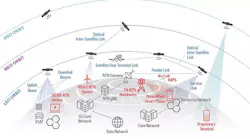
Cellular and satellite connectivity extend IoT communications beyond the reach of conventional local wireless networks. LTE-M and NB-IoT support connected devices that need wide-area coverage and efficient data transmission, while non-terrestrial networks (NTNs) can extend connectivity to remote locations and areas underserved by terrestrial infrastructure. Successful deployment depends on module capabilities, network standards, testing, and certification. These articles explore cellular IoT implementation, the expansion of satellite-enabled connectivity, and validation of emerging NTN technologies.




RF Communications Fundamentals, Timing, and System Design
Wireless performance depends on the underlying RF engineering as much as on the selected communications protocol. Band selection, channel bandwidth, antenna size, timing accuracy, and signal processing all affect the reliability and efficiency of connected devices. Ultra-wideband (UWB) enables applications that benefit from precise ranging and timing, while multiple-input, multiple-output (MIMO) techniques and compact antennas help support higher performance in space-constrained products. Learn more about foundational RF concepts and design trade-offs that influence IoT system architecture and real-world performance.