Digital Twins Bring Circuit Optimization Online
What you’ll learn:
- How digital twins are transforming RF/microwave circuit design.
- The role of agentic AI in dynamic circuit optimization.
- How integrated sensing and communication (ISAC) fuels dynamic resource allocation.

Electronic design automation (EDA) and electromagnetic (EM) simulation have long been staples of RF/microwave circuit design, but they both have critical limitations. Namely, these traditional forms of simulating RF components, circuits, modules, and/or complete systems struggle with models that can’t perfectly capture some of the factors that most affect real-world performance: parasitics, EM coupling, thermal effects, material tolerances, packaging, antenna interactions, and nonlinear behavior.
Digital twins have begun to profoundly transform RF/microwave circuit design, not the least of which being the technology’s ability to allow the twin to evolve alongside the physical hardware. Following a demonstration of MathWorks’ capabilities at IMS 2026 in Boston, we invited the company and Keysight EDA to participate in a July webinar that shed further light on the topic of artificial intelligence (AI) and machine learning in RF/microwave design tools.
Here, we follow up with MathWorks’ Houman Zarrinkoub, Principal Product Manager for Wireless Communications, for more perspective on the role of digital twins in RF/microwave design.
Microwaves & RF: I was shown a demonstration at IMS in Boston by Georgia Zucchelli, your colleague at MathWorks, that exemplified a shift in RF and microwave design away from manual, simulation-heavy workflows, and more toward an intent-driven workflow in which the designer specifies goals and constraints. An agentic-AI engine uses those goals to explore and optimize the design space. How does agentic AI help designers shape how those systems behave when they're running in real-time?
Houman Zarrinkoub: Agentic AI is useful because it changes the way the wireless and RF system designers look at their design as it's implemented in hardware and operates in real-time. Historically, the design was a best estimate derived from basic principles. You program it, you parameterize it, and there’s a static program that goes into your RF system, or into your wireless devices.
With the advent of agentic AI, the mentality has changed. If agentic AI can understand intent and react continuously to update the program, why don't we put that into RF and wireless systems? In other words, the notion of an RF digital twin rather than software that responds to your communication needs being static.
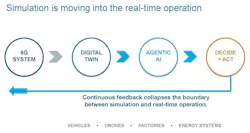
Say you have a digital twin that’s very aware of the environment, of the sensing, of all the conditions. This software responds to the dynamic nature of the input that's changing in the system. Then, in real-time, that dynamic software can respond much better to the circumstances and optimize your system while in operation. So, optimization goes from offline design stage to online operational stage (Fig. 1).
Let’s go a little deeper into that. How do digital twins help bring, say, a 6G air interface into a real-world setting. How does that work?
The best thing about 6G and the timing of it with agentic AI is that two technologies in 6G go very well in concert together. One of them is the advent of RF digital twin technology, meaning that the system installed on your cell phone or in the base station or other system components are situationally aware. They have a digital twin, a very detailed explanation and state monitoring of what’s going on around them.
Another important technology that's exciting in the 6G context is integrated sensing and communication (ISAC). What’s ISAC? Well, for example, you and I are ISACs. In our brains, we integrate sensing and action, sensing, and talking. That capability will be put inside every base station, inside every phone, where they keep sensing.
The ISAC signal is sent to the RF digital twin software, which continuously programs and reprograms to do the right thing based on the requirements of a given moment. If the signal is high or low, it will react instantaneously. In this manner, 6G will bring that old dream of dynamic resource allocation, dynamic optimization, and real-time optimization to reality, because you have a digital twin, a self-programming software fed by real-time sensing. So, these two technical advancements are going to make that dream a reality.
As an engineer runs these digital twins, and the AI engine is acting on the basis of the goals and conditions or limits that they've set, how does the engineer make sure that the AI engine is actually working within the limits, even when the conditions are changing? Perhaps it starts raining or snowing. How does that work?
Again, if you remember, previously the design was static. The engineer, in his or her mind, thinks of all the possible eventualities and programs something to account for them into the parameters. Now, the design is dynamic and real-time, so it may diverge into a place that you don't want to go (Fig. 2). Maybe there's too much rain, and it overcompensates.
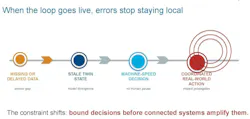
The designers of the future will use skills and knowledge graphing and a knowledge base. They’ll put these guardrails around the metrics and key performance indicators (KPIs) and measurements, so that the sensed information updates your operations in real-time but will not go beyond these limits.
Instead of providing static instructions for how the system should work with this signal and that signal, and this modulation or that modulation, the RF digital twin software enables it to react to reality as conditions change but to ensure these metrics are never violated. By putting these guardrails in place and embedding skills into the design process, convergence is guaranteed and divergence is avoided, but flexibility is maintained. Lots of choices and design and operational tradeoffs can be handled.
You’ve used the word “skills,” for what these limits and goals can be thought of in terms of the AI. What are the implications for those limits in terms of how the AI interacts with them?
Those skills are derived by us looking at the best practices of the past. When has, in the past, the system gone to saturation? When has the system experienced too much fading? Those skills are the best practices that we’re adding, telling the system how to respond to various conditions (Fig. 3).
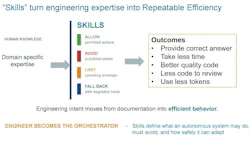
But there are limitations. I don't think at this point RF engineers are ready to declare that all possible eventualities and problems can be handled. But as we build these dynamic systems, and because they have RF digital twin technology, they show what's going on with the state of the system when bad things happen, and then their skills can hopefully be updated.
So, in the early stages, we do the best we can with limited skills providing guardrails and guarantees. But over time, we learn more about how the system reaches less optimal states and add additional skills to ensure it meets the requirements in all conditions.
Do you think the design community will trust the tools to do this efficiently? This has been a running topic in electronic design automation (EDA) for decades, going back to the old concept of system-level design.
The trust comes in three levels, the first being trust in the underlying physics and mathematics. If you know that the math and formulas are solid, then the second level of trust is in whether the software can reliably represent that. The MATLAB and Python platforms are known to offer guaranteed numerical accuracy. The third level of trust is whether the MATLAB or Python outputs can be reliably moved from software to hardware.
So, there are three levels of translation from high level to low level, and we are in the middle. The best thing about agentic AI is that the smart guys who can prove mathematically that this can or cannot be done will be on the front lines of validating agentic AI.
Agentic AI does the best it can based on academic inputs and so on. But then someone who knows math says, “This is inconsistent.” So, as an optimist, I’m hoping that smart guys will show up at the first level, at the mathematical foundation level, and check it.
We (at Mathworks) are making sure that if an idea is mathematically sound, we implement it correctly in numerics, and then it can move on to a third-level hardware implementation. Historically, this process has been done by humans. Now we’re replacing it with agents. The tools are helping humans.
About the Author
 David Maliniak
Executive Editor, Microwaves & RF
I am Executive Editor of Microwaves & RF, an all-digital publication that broadly covers all aspects of wireless communications. More particularly, we're keeping a close eye on technologies in the consumer-oriented 5G, 6G, IoT, M2M, and V2X markets, in which much of the wireless market's growth will occur in this decade and beyond. I work with a great team of editors to provide engineers, developers, and technical managers with interesting and useful articles and videos on a regular basis. Check out our free newsletters to see the latest content.
You can send press releases for new products for possible coverage on the website. I am also interested in receiving contributed articles for publishing on our website. Use our contributor's packet, in which you'll find an article template and lots more useful information on how to properly prepare content for us, and send to me along with a signed release form.
About me:
In his long career in the B2B electronics-industry media, David Maliniak has held editorial roles as both generalist and specialist. As Components Editor and, later, as Editor in Chief of EE Product News, David gained breadth of experience in covering the industry at large. In serving as EDA/Test and Measurement Technology Editor at Electronic Design, he developed deep insight into those complex areas of technology. Most recently, David worked in technical marketing communications at Teledyne LeCroy, leaving to rejoin the EOEM B2B publishing world in January 2020. David earned a B.A. in journalism at New York University.
Related
 dreamstime_m_137795256


 Leaders Logo
Leaders relevant to this article: