High-Speed Processor Boosts Advanced Space Systems
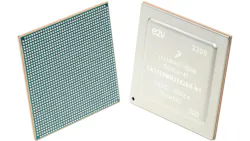
A high-speed microprocessor developed by Teledyne e2v Semiconductors promises to bring high-speed, high-capacity processing and networking to compact spacecraft for advanced computing during space missions.
The Model LX2160-Space microprocessor (see image above) employs error-correction-code (ECC) technology and two DDR4 memory interfaces operating to 3.2 GT/s. It builds on the firm’s 16-core, 64-bit Arm Cortex-A72 processor architecture, supporting wide-bandwidth, artificial-intelligence (AI) applications to 2.2 GHz including Earth observation, image processing, high-speed communications, and spacecraft avionics.
The space-grade processor incorporates multiple PCIe Gen3 controllers, packet-processing acceleration, a 100-Gb/s data compression engine, and a 50-Gb/s security accelerator to provide Gigabit Ethernet service to 100 Gb/s. The device is available through multiple qualification processes to match multiple mission requirements, including NASA Levels 1, 2 and 3; ECSS Class 3; and Teledyne e2v’s X1 New Space grade qualification process.
Regarding the processor, Frédéric Devrière, marketing product manager for Teledyne e2v Semiconductors, said, “With LX2160-Space, spacecraft designers can process images onboard, support autonomous operation, and handle high-speed data, while choosing qualification options that fit their mission needs. They can also benefit from the full ecosystem around the LX2160.”
The device will be part of a demonstration at the Space Tech Expo Europe (Bremen, Germany) scheduled from November 17-19, 2026, in which multiple AI image-processing algorithms are running concurrently.
Learn more about space-qualified devices



About the Author
Jack Browne
Technical Contributor
Jack Browne, Technical Contributor, has worked in technical publishing for over 30 years. He managed the content and production of three technical journals while at the American Institute of Physics, including Medical Physics and the Journal of Vacuum Science & Technology. He has been a Publisher and Editor for Penton Media, started the firm’s Wireless Symposium & Exhibition trade show in 1993, and currently serves as Technical Contributor for that company's Microwaves & RF magazine. Browne, who holds a BS in Mathematics from City College of New York and BA degrees in English and Philosophy from Fordham University, is a member of the IEEE.