How to Fulfill Ever-Growing Spacecraft Memory Needs
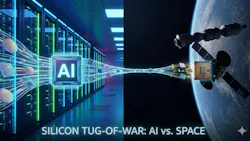
Demand for computer memory grows with each data center. The ever-increasing needs are driving memory prices higher and impacting diverse industries, including programs in space.
To address the changing memory landscape, an article from Mercury Systems, “Spacecraft Memory in the Age of AI Hyperscaling: Turning Obsolescence into an Engineering Discipline,” written by Vincent Pribble, Space Product Manager, suggests that device obsolescence be planned for rather than shunned. It can be the heart of an innovative approach to use aging memory chips in space-based electronic systems.
The whitepaper addresses the changing performance and applications of dynamic random-access memory (DRAM) and NOT AND (NAND) memory devices, including in low-Earth-orbit (LEO) satellite systems (see image above).
Using payloads reliant on commercial-off-the-shelf (COTS) electronics, these systems relied on DRAM and NAND devices in which legacy memory die have been available for decades. But with the rapid expansion of artificial intelligence (AI), and the need for higher-bandwidth memory chips in AI accelerators, data-center-class processors are being used in LEO satellite systems.
On-orbit AI inference and edge processing drive spacecraft memory demands even higher. The legacy memory market, which once supported memory devices for decades, is now changing rapidly and memory design requirements are resulting in faster product turnarounds.
The whitepaper explains that even COTS memory solutions for space are more difficult to procure with these growing demands. However, planning for memory device obsolescence as part of a continuous engineering discipline by regularly monitoring memory product lifecycle alerts as part of the development of space-based systems can circumvent the loss of legacy memory products.
Learn more about Mercury Systems and space-borne memory



About the Author
Jack Browne
Technical Contributor
Jack Browne, Technical Contributor, has worked in technical publishing for over 30 years. He managed the content and production of three technical journals while at the American Institute of Physics, including Medical Physics and the Journal of Vacuum Science & Technology. He has been a Publisher and Editor for Penton Media, started the firm’s Wireless Symposium & Exhibition trade show in 1993, and currently serves as Technical Contributor for that company's Microwaves & RF magazine. Browne, who holds a BS in Mathematics from City College of New York and BA degrees in English and Philosophy from Fordham University, is a member of the IEEE.


 Leaders Logo
Leaders relevant to this article: