Network Synchronizers Serve AI Data Centers and Time-Sensitive Infrastructure
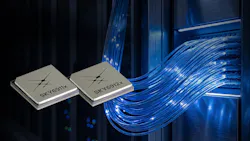
With data rates rising, network infrastructure demands precise timing, less complexity, and faster system integration. For settings like AI data centers and other time-sensitive scenarios, Skyworks Solutions' SKY6911x/2x family of NetSync network-synchronizer clocks combines network synchronization features, including IEEE-1588 Precision Time Protocol (PTP) support, ITU-T-compliant Synchronous Ethernet wander filtering, and the ability to lock to GNSS receiver clock outputs.
The devices’ ultra-low-jitter clock generation supports 224G/448G SerDes interfaces enabling 800-Gb/s and 1.6-Tb/s networking platforms.
More traditional timing architectures rely on separate hardware devices for synchronization and jitter attenuation, along with third-party software, to implement a complete synchronization framework. In contrast, Skyworks’ SKY6911x/2x NetSync family integrates these functions into a single IC.
Working seamlessly with the company's AccuTime synchronization software, the SKY6911x/2x enables system designers to optimize synchronization designs for performance, power consumption, and PCB footprint. This greatly reduces the hardware and software design load to support synchronization in telecommunications infrastructure, data centers, AI systems, and broadcast video-production facilities.
Synchronizers Bring Architectural Flexibility
With these network synchronizers, designers have architectural flexibility: By leveraging Skyworks’ DSPLL and MultiSynth technologies, users can simplify reconfigurability to support different topologies and address varying system architectures and requirements.
Support for physical-layer clock standards like Synchronous Ethernet and IEEE-1588 PTP packet-based timing lends these devices to such diverse applications as telecommunications, AI data-center synchronization, and video production genlock.
There’s also enhanced time-of-day (ToD) support, brought by high-resolution ToD counters and timestamping combined with flexible encoding protocols and multiple physical-layer options. The result is seamless ToD interconnection to many third-party clocks, switches, and PHYs. It also enables time distribution over existing backplane designs.
A key element of the overall scheme is Skyworks’ AccuTime synchronization software, which incorporates the software-layer aspects of a modern synchronization scheme. A full IEEE-1588 (PTP) stack supports common PTP profiles across multiple industries, while a highly advanced time-recovery servo makes it possible to achieve accurate time alignment over even the noisiest of networks.
The full-featured SKY69115 (general-purpose network synchronizer), SKY69110 (centralized network synchronizer with ToD) and SKY69120 (line-card network synchronizer with ToD) BGA-based devices are available now.
The smaller-form-factor SKY69116 (general-purpose network synchronizer), SKY69112 (centralized network synchronizer with ToD) and SKY69122 (line-card network synchronizer with ToD) QFN-based devices are expected to be available in early 2027.
About the Author
 David Maliniak
David Maliniak
Executive Editor, Microwaves & RF
I am Executive Editor of Microwaves & RF, an all-digital publication that broadly covers all aspects of wireless communications. More particularly, we're keeping a close eye on technologies in the consumer-oriented 5G, 6G, IoT, M2M, and V2X markets, in which much of the wireless market's growth will occur in this decade and beyond. I work with a great team of editors to provide engineers, developers, and technical managers with interesting and useful articles and videos on a regular basis. Check out our free newsletters to see the latest content.
You can send press releases for new products for possible coverage on the website. I am also interested in receiving contributed articles for publishing on our website. Use our contributor's packet, in which you'll find an article template and lots more useful information on how to properly prepare content for us, and send to me along with a signed release form.
About me:
In his long career in the B2B electronics-industry media, David Maliniak has held editorial roles as both generalist and specialist. As Components Editor and, later, as Editor in Chief of EE Product News, David gained breadth of experience in covering the industry at large. In serving as EDA/Test and Measurement Technology Editor at Electronic Design, he developed deep insight into those complex areas of technology. Most recently, David worked in technical marketing communications at Teledyne LeCroy, leaving to rejoin the EOEM B2B publishing world in January 2020. David earned a B.A. in journalism at New York University.