M2M Position-Data Transfer Module Monitors Sensors in Industrial Settings
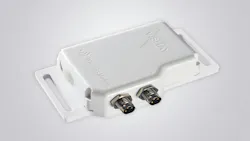
With operation in the 2.40-GHz ISM band, Vishay Intertechnology’s Sfernice WLMO wireless module enables remote monitoring of analog precision sensors in industrial applications. The LoRa-based, machine-to-machine (M2M) wireless position-data transfer module supports long-range communication while maintaining low power consumption for battery-powered operation.
The WLMO module powers up to two analog position sensors, from which it acquires data that's wirelessly transmitted to the user’s receiver/gateways for processing at the host system. It operates using a proprietary protocol layer over LoRa modulation, which must be implemented within the user’s system and receiver/gateways.
The node features a 12-bit internal analog-to-digital converter (ADC) and sealed M8x1 three-pole connectors for reliable sensor interfacing. Supporting both potentiometric and contactless technologies, the device delivers actuator position data to communication infrastructures, serving as a key link in the end-to-end chain toward cloud-based monitoring for enhanced operational visibility and informed decision-making.
Operating on a private LoRa network, the WLMO doesn't require a radio license and supports communication up to 2 km in open-field environments. Optimized bandwidth utilization, with duty cycles up to 10%, enables efficient, reliable communication, while high receiver sensitivity of –140 dBm delivers robust wireless performance.
Low transmit power of 7.08 mW (8.5 dBm) supports autonomous battery-powered operation for up to two years on a single battery set. Battery-level monitoring simplifies maintenance planning, while a sealed mechanical switch provides secure activation and pairing during commissioning.
The WLMO’s radio architecture supports five selectable frequency bands, with independent transmission and reception channels featuring ±200 kHz of bandwidth each. Combined with six configurable spreading factor levels, this provides fine-grained tuning capabilities, ensuring modular integration within existing ecosystems of nodes, receiver/gateways, and sensors.
The device also supports bidirectional communication for reliable data exchange within LoRa networks.
The node is well-suited for industrial automation and infrastructure applications requiring IoT sensor integration for actuators, position data acquisition in low-frequency systems, and predictive or condition-based maintenance in Industry 4.0 and smart factory environments. Additional uses include energy metering, precision farming, and agritech.
In those applications, the WLMO simplifies deployment by eliminating the need for wiring, enhances safety through position verification, and reduces operating expenses through remote configuration via receiver/gateways.
Measuring 89 × 55.5 × 21.6 mm, the RoHS-compliant module is a compact and rugged outdoor-ready device. It features an IP67-rated sealed enclosure and UV-resistant housing compliant with ISO 4892-2 for reliable long-term operation in harsh environments.
Samples and production quantities of the WLMO are available now, with lead times of 14 weeks. Pricing for U.S. delivery starts at $75 per piece in 250-piece quantities.
Learn more about M2M technologies




About the Author
 David Maliniak
Executive Editor, Microwaves & RF
I am Executive Editor of Microwaves & RF, an all-digital publication that broadly covers all aspects of wireless communications. More particularly, we're keeping a close eye on technologies in the consumer-oriented 5G, 6G, IoT, M2M, and V2X markets, in which much of the wireless market's growth will occur in this decade and beyond. I work with a great team of editors to provide engineers, developers, and technical managers with interesting and useful articles and videos on a regular basis. Check out our free newsletters to see the latest content.
You can send press releases for new products for possible coverage on the website. I am also interested in receiving contributed articles for publishing on our website. Use our contributor's packet, in which you'll find an article template and lots more useful information on how to properly prepare content for us, and send to me along with a signed release form.
About me:
In his long career in the B2B electronics-industry media, David Maliniak has held editorial roles as both generalist and specialist. As Components Editor and, later, as Editor in Chief of EE Product News, David gained breadth of experience in covering the industry at large. In serving as EDA/Test and Measurement Technology Editor at Electronic Design, he developed deep insight into those complex areas of technology. Most recently, David worked in technical marketing communications at Teledyne LeCroy, leaving to rejoin the EOEM B2B publishing world in January 2020. David earned a B.A. in journalism at New York University.