Ground Terminal Plus Network Transfers 5G from Space at 26 GHz
By combining satellites with near-millimeter-wave frequency bandwidths at 26 GHz, Univity has shown its uniSpark system capable of high-speed internet access from space to Earth. Using very-low Earth-orbit (VLEO) satellites, the firm completed time-division-duplex (TDD) communications links from orbit to Earth to support 5G wireless communications networks.
Launched in 2025, uniSpark is capable of a fully bidirectional 5G non-terrestrial-network (NTN) connection between a satellite ground terminal and a 5G base station onboard an orbiting satellite. Demonstration of the link was supported by the France 2030 technology program and conducted from a Central National d’Etudes Spatiales (CNES) site. In just under two years, Univity collaborated with its partners to bring the communications demonstration from concept to reality.
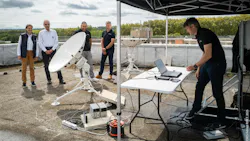
The uniSpark system employs high-frequency microwave bands at 26 GHz coupled with TDD technology. The demonstration employed a ground terminal synchronized and registered as a 5G terminal on the uniSpark network (see image above).
The connection involves a protocol like that of terrestrial 5G TDD networks, except that the connection is with a base station located several hundred kilometers above Earth and traveling at orbital velocity. The distance between the two is constantly changing, requiring corrections for propagation delays. Also, the TDD equipment must be closely synchronized for proper operation.
Unlike frequency division duplexing (FDD), which uses separate spectrum equipment to transmit and receive, TDD can share the same spectrum resources over time between uplinks and downlinks for increased efficiency.
As Univity validates the performance of uniSpark, it's also developing its uniShape system consisting of two satellites, which will integrate into the terrestrial/satellite communications network with uniSpark. Furthermore, uniSky will be part of future industrialization and deployment of the combination terrestrial/satellite constellations.
Concerning the advances, Laurence Clarac, Head of Innovative Concepts and Satcom Applications at CNES, said, “By hosting the ground equipment for the demonstration, CNES contributed to the success of these in-orbit tests. This major milestone marks the completion of the first phase of Univity’s roadmap. It will be followed by a 5G service demonstration project, supported by CNES under the France 2030 program and signed in August 2025.”
Learn more about satellite communications

About the Author
Jack Browne
Technical Contributor
Jack Browne, Technical Contributor, has worked in technical publishing for over 30 years. He managed the content and production of three technical journals while at the American Institute of Physics, including Medical Physics and the Journal of Vacuum Science & Technology. He has been a Publisher and Editor for Penton Media, started the firm’s Wireless Symposium & Exhibition trade show in 1993, and currently serves as Technical Contributor for that company's Microwaves & RF magazine. Browne, who holds a BS in Mathematics from City College of New York and BA degrees in English and Philosophy from Fordham University, is a member of the IEEE.