FPGA Family Adds Spaceflight Qualifications
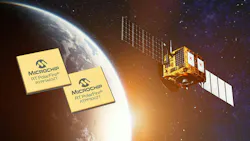
By expanding device options for mission-critical space applications, Microchip Technology earned new Defense Logistics Agency (DLA) spaceflight qualifications for its radiation-tolerant (RT) PolarFire FPGA and SoC families. The RT PolarFire SoC FPGA RTPFS460ZT also completed QML Class Q and MIL-STD-883 Class B qualifications.
Legacy SRAM-based FPGAs require configuration scrubbing to correct radiation-induced upsets, which can increase power consumption. On the other hand, RT PolarFire devices use configuration technology designed to eliminate configuration single-event upset (SEU) concerns.
Features include single-event latch-up (SEL) radiation performance and in-flight programmability for mission-critical space applications requiring high reliability for demanding missions.
Combining programmable logic with an integrated microprocessor subsystem (MSS), the RTPFS460ZT PolarFire SoC FPGA features 64-bit RISC-V processor cores. It's available with development kits, together with a common RT PolarFire architecture and tool flow, to help streamline evaluation, prototyping, and flight-system development.
Related links:
More New Products

About the Author
 Alix Paultre
Editor-at-Large, Microwaves & RF
Alix is Editor-at-Large for Microwaves & RF.
An Army veteran, Alix Paultre was a signals intelligence soldier on the East/West German border in the early ‘80s, and eventually wound up helping launch and run a publication on consumer electronics for the U.S. military stationed in Europe. Alix first began in this industry in 1998 at Electronic Products magazine, and since then has worked for a variety of publications, most recently as Editor-in-Chief of Power Systems Design.
Alix currently lives in Wiesbaden, Germany.