AFRL Places Bet on Galvorn High-Power Cathodes
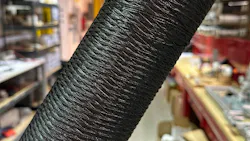
The U.S. Air Force Research Laboratory (AFRL) requires generous microwave power for numerous applications and is seeking lightweight, conductive material to construct active devices with high-power electromagnetic (EM) field-emission cathodes, including Galvorn material from DexMat. The material, invented at Rice University, is coming to AFRL by way of Tactical Funding Increase (TACFI) contract (FA2394−26−C-B006) awarded to AFWERX within the Technology Transition Office of AFRL.
The material’s characteristics hold great promise not only for defense-related applications, but for high-power microwave handling in automotive, energy, and space applications. The two-year contract requires DexMat to produce more than 1 kg of properly qualified Galvorn fiber material for cathode development.
Compared to currently used cathode materials, Galvorn fibers have been tested and shown to be capable of emitting more than 20X the current density of those competing cathode materials.
Dr. Dmitri Tsentalovich (PhD), director of product innovation at DexMat, noted, “We've been working toward this since Galvorn was still a research project at Rice. AFRL has followed this cathode data for years. This contract is a bet on where that data goes next.”
Galvorn (see image above) is one-fifth the density of copper but 97% as conductive as copper for forming powerful but lightweight cathodes in high-energy microwave tubes and other devices.
Learn more about hollow-state technologies



About the Author
Jack Browne
Technical Contributor
Jack Browne, Technical Contributor, has worked in technical publishing for over 30 years. He managed the content and production of three technical journals while at the American Institute of Physics, including Medical Physics and the Journal of Vacuum Science & Technology. He has been a Publisher and Editor for Penton Media, started the firm’s Wireless Symposium & Exhibition trade show in 1993, and currently serves as Technical Contributor for that company's Microwaves & RF magazine. Browne, who holds a BS in Mathematics from City College of New York and BA degrees in English and Philosophy from Fordham University, is a member of the IEEE.
Related
 desept31_promo


 Leaders Logo
Leaders relevant to this article: