Batteries Help Drones Surpass 8-Hour Flight Time

A Group 1 small uncrewed aerial system (UAS) recently established a new flight-time record of 8 hours, 41 minutes, and 43 seconds, flying 300 miles with a pair of brushless DC motors under battery power. Surpassing the previous record by 50 minutes, the drone flight record was achieved in desert heat during the Game of Drones 26-2 demonstration at Edwards Air Force Base, Ca., using two DC motors assembled at Tobyhanna Army Depot in Pennsylvania.
The battery-powered drone flight-time record is a milestone for Army Materiel Command (AMC), driven by its efforts to establish secure domestic supply chains for the drone’s two brushless DC motors.
According to U.S. Army Captain Lee Washburn, AMC military liaison for advanced manufacturing of small UAS, “AMC is proud to provide materiel solutions to support innovation across the uncrewed systems spectrum.”
Washburn explained AMC’s role in supporting the Army, “From providing components to soldiers at innovation labs, to providing industry clean supply chain solutions in support of drone dominance, it is our goal to continue to participate in events that demonstrate our capabilities and help refine our components for the warfighter based upon realistic testing.”
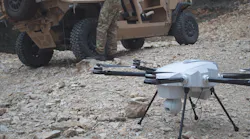
The drone (see image above) was designed in less than 10 minutes using prompts from computer-aided adaptability software. It was fabricated within 24 hours of takeoff, inside a mobile containerized production factory. The mobile manufacturing site uses commercial 3D printers and a three-person production team to integrate the two brushless motors and a battery from an industrial partner into the long-distance small drone.
Learn more about advances in UAV technologies
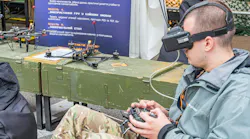 dreamstime_mistertigga_349542726
About the Author
Jack Browne
Technical Contributor
Jack Browne, Technical Contributor, has worked in technical publishing for over 30 years. He managed the content and production of three technical journals while at the American Institute of Physics, including Medical Physics and the Journal of Vacuum Science & Technology. He has been a Publisher and Editor for Penton Media, started the firm’s Wireless Symposium & Exhibition trade show in 1993, and currently serves as Technical Contributor for that company's Microwaves & RF magazine. Browne, who holds a BS in Mathematics from City College of New York and BA degrees in English and Philosophy from Fordham University, is a member of the IEEE.