Students Power Drone with Hydrogen and Honeywell's Help
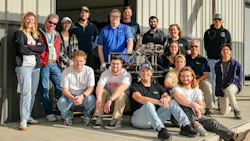
Mechanical engineering students at Embry-Riddle Aeronautical University teamed with Honeywell Aerospace to retrofit a fixed-wing drone with a hydrogen-powered fuel system.
Known as the GHOST project (sponsored by Honeywell Aerospace), students from the school’s Daytona Beach and Prescott campuses (see image above) helped Honeywell explore the viability of hydrogen as a propulsion source for uncrewed aircraft systems (UAS), as an alternative to gasoline- and battery-powered aircraft. The team lead at the Prescott campus, Joshia Siegler, admitted, “We had all these questions and no answers. That kind of set the tone for the rest of the project.”
Ian Martin, an advanced project engineer with Honeywell Aerospace and the project’s industry advisor, said the project exposed students to the realities of introducing new technology into a developing market. “The requirements were broad, and I encouraged the students to perform their own market research to think critically about the needs of the customer when choosing the platform,” added Martin.
The Prescott team handled fuel-cell integration and testing, and the Daytona Beach team performed modeling of the drone, which was called “Penguin C.”
Carter Bitz, the Daytona Beach team lead involved in aircraft modeling and simulation, noted that integration of their efforts was critical, “The entire basis of the project was to have our pieces fall into place and fit together to complete our mission.”
Students had to manage weight, center of gravity, thermal systems, and compressed hydrogen storage and whether existing aircraft could be modified for use with hydrogen or if new airframes were needed. Overcoming the many challenges, the student/industry team successfully integrated the hydrogen fuel-cell system into the aircraft and validated its functionality through ground-based testing. A full flight test lies ahead.
Honeywell’s Martin explained that the two teams have already exceeded expectations. “The students went above and beyond in response to a difficult, but real-world example of system integration and cross-team collaboration. I’m very proud of their ability to tackle the ambiguity and put together a product that is representative of the system integration work we do internally.”
Learn more about drone technologies
 dreamstime_mistertigga_349542726
About the Author
Jack Browne
Technical Contributor
Jack Browne, Technical Contributor, has worked in technical publishing for over 30 years. He managed the content and production of three technical journals while at the American Institute of Physics, including Medical Physics and the Journal of Vacuum Science & Technology. He has been a Publisher and Editor for Penton Media, started the firm’s Wireless Symposium & Exhibition trade show in 1993, and currently serves as Technical Contributor for that company's Microwaves & RF magazine. Browne, who holds a BS in Mathematics from City College of New York and BA degrees in English and Philosophy from Fordham University, is a member of the IEEE.