Compact Comb Generators Command Optical O- and C-Bands
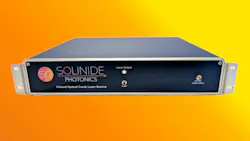
Optical wavelengths continue to be occupied for multiple carriers and applications such as communications and sensing. Testing combs of light has traditionally required large, power-hungry lasers, but now there's an alternative: the LumiCOMB optical frequency comb generator from Solinide Photonics AB.
Based on the firm’s patented silicon-nitride (SiN) micro-resonator technology, the comb generator is available for O-band (1,260 to 1,360 nm) and C-band (2,530 to 2,565 nm) optical fiber wavelengths. Packed in a 2U-high, 19-in. rack-mount enclosure weighing less than 10 kg and consuming only about 30 W, each LumiCOMB unit replaces a much larger rack of lasers as optical test sources for evaluating optical systems at phase-locked wavelengths.
LumiCOMB comb generators are highly efficient, multiple-carrier sources for a variety of test applications, such as in communications, imaging, metrology, and sensing systems. They produce a broadband comb with evenly spaced phase-coherent lines across the wavelength.
The comb generators feature simple single-switch control to transition from standby to full operational mode, with a linear-polarized comb on a PMF slow axis fiber and available at a single FC/APC connector. The rack-mount enclosures weigh less than 10 kg and consume about 30 W power in normal use.
Well-suited for optical frequency calibration and wavelength referencing, O-band comb generators feature a distributed-feedback (DFB) pump laser wavelength of 1,270 to 1,330 nm and 24 usable optical pump lines with greater than –5-dBm power levels for a comb FSR of 200 GHz (see image above). The typical optical signal-to-noise ratio (OSNR) is 40 dB.
The team that founded Solinide Photonics started life prototyping SiN-based photonic integrated circuits (PICs) in the research laboratories of Chalmers University. The company’s CEO, Marcello Girardi, revealed that Solinide’s SiN foundry service, driven by precise photolithography, contributed a great deal to the development of the LumiCOMB comb generators: “LumiCOMB is supported by Solinide's foundry service, which provides unique delivery and technical advantages compared to similar market counterparts.”
He noted that the Swedish-based engineering team is close to the instrument, “Solinide offers direct support from the technical team who developed and built the platform, featuring production in Sweden.” O-band units are expected to be available shortly, with C-band comb generators in production soon thereafter.
Learn more about comb generators and optical communications
 5 G Promo
About the Author
Jack Browne
Technical Contributor
Jack Browne, Technical Contributor, has worked in technical publishing for over 30 years. He managed the content and production of three technical journals while at the American Institute of Physics, including Medical Physics and the Journal of Vacuum Science & Technology. He has been a Publisher and Editor for Penton Media, started the firm’s Wireless Symposium & Exhibition trade show in 1993, and currently serves as Technical Contributor for that company's Microwaves & RF magazine. Browne, who holds a BS in Mathematics from City College of New York and BA degrees in English and Philosophy from Fordham University, is a member of the IEEE.