Whitepaper Details Direction-Finding Methods

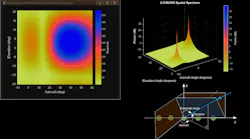
Direction-finding (DF) techniques with radio waves are useful methods of tracking targets over a distance, typically using reflected pulsed signals in radar systems. A nine-page whitepaper from Signal Hound, “Direction Finding with Multi-Channel Receivers,” explains three well-established DF methods — angle of arrival (AoA), time difference of arrival (TDoA), and pseudo-Doppler approaches — and how they can be realized in practical modern DF systems.
The whitepaper compares the accuracy and implementation complexity of each method and the antenna-switching and receiver requirements for the best results. For example, AoA uses an antenna array, comparing signal characteristics as received by multiple antennas in the array.
TDoA employs multiple receivers across a geographic area of interest to locate a signal transmitter. TDoA receivers are simple but require accurate timing among receivers, as is possible with a common timing source such as the Global Positioning System (GPS).
The whitepaper includes several receiver options from Signal Hound for implementing TDoA systems. The model SM435C receiver covers 100 kHz to 43.5 GHz with an onboard GPS subsystem for timestamping accuracy of ±40 ns. With an upper limit of 14.5 GHz, the SP145 receiver also has onboard GPS receiver for accurate timestamping.
The company’s model PCR4200 multi-channel phase-coherent receiver supports the third DF method through the accurate measurement of signal phase. The whitepaper provides details on all three DF methods as well as hybrid combinations of the three and how to apply the receivers for numerous frequency ranges and bandwidths. It also describes how measurements can be simplified with the company’s Spike software.
Learn more about angle-of-arrival technologies

About the Author
Jack Browne
Technical Contributor
Jack Browne, Technical Contributor, has worked in technical publishing for over 30 years. He managed the content and production of three technical journals while at the American Institute of Physics, including Medical Physics and the Journal of Vacuum Science & Technology. He has been a Publisher and Editor for Penton Media, started the firm’s Wireless Symposium & Exhibition trade show in 1993, and currently serves as Technical Contributor for that company's Microwaves & RF magazine. Browne, who holds a BS in Mathematics from City College of New York and BA degrees in English and Philosophy from Fordham University, is a member of the IEEE.
Related


 Leaders Logo
Leaders relevant to this article: