6U OpenVPX GPGPU Processing Cards Handle Embedded-Edge Duties
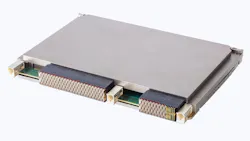
The proliferation of high-resolution sensors on the connected battlefield, and the need for speed in gathering and processing their critical data, drives the requirement for more powerful edge-processing hardware. To that end, EIZO Rugged Solutions has introduced the Condor XR2S 6U VPX Series of high-performance computer and GPGPU processing cards. These cards, offered in an OpenVPX 6U form factor, are based on the NVIDIA RTX PRO Blackwell architecture.
Designed for high-throughput embedded-edge computing, the Condor XR2S Series enables advanced GPGPU processing for applications including EO/IR sensor processing, fire radar control, AI inference, signal processing, and real-time video analytics. The series includes the Condor XR2S-B5000 based on the NVIDIA RTX PRO 5000 Blackwell Embedded GPU, and the Condor XR2S-B4000 built with the NVIDIA RTX PRO 4000 Blackwell Embedded GPU.
The Condor XR2S series offers dual NVIDIA RTX PRO Blackwell GPUs on a single 6U VPX payload, enabling parallel execution of compute-intensive workloads while maximizing processing density within VPX-based systems. In addition, the 6U VPX modules incorporate dual Microchip Switchtec PFX PCIe Gen4 switches, enabling a flexible and reliable high-bandwidth, low-latency interconnect between the GPUs and VPX backplane fabric.
The architecture supports peer-to-peer GPU communication and optimized PCIe lane distribution, minimizing host CPU overhead and improving overall system throughput. Each GPU can be independently configured to support multiple endpoint configurations.
The PCIe switches also allow mating I/O modules to communicate directly with either the host CPU or the GPUs through NVIDIA GPUDirect remote direct memory access (RDMA).
The NVIDIA Blackwell architecture supports GDDR7 memory capacity and GPUDirect RDMA. This allows systems to manage larger datasets and more complex parallel workloads, improving performance for high-throughput HPEC applications such as AI inference, signal processing, and sensor fusion.
In addition, the Blackwell architecture supports Multi-Instance GPU (MIG), making it possible to securely and efficiently split up a single NVIDIA RTX PRO Blackwell GPU into multiple fully isolated GPU instances, each with dedicated compute cores, cache, and high-bandwidth memory. This enables system architects to allocate GPU resources dynamically across different applications, sensor pipelines, or AI models running in parallel.
Designed to meet MIL-STD-810 environmental specifications for temperature, shock, and vibration, the Condor XR2S Series delivers robust performance in the most demanding environments. The series is fully aligned with the SOSA Technical Standard, supporting 10.6.4 slot profiles, reinforcing its versatility and readiness for next-generation HPE deployments.
Learn more about embedded edge processing
 dreamstime_mkmult_329176844_promo
 Marina Putilova Dreamstime L 225672133
About the Author
 David Maliniak
David Maliniak
Executive Editor, Microwaves & RF
I am Executive Editor of Microwaves & RF, an all-digital publication that broadly covers all aspects of wireless communications. More particularly, we're keeping a close eye on technologies in the consumer-oriented 5G, 6G, IoT, M2M, and V2X markets, in which much of the wireless market's growth will occur in this decade and beyond. I work with a great team of editors to provide engineers, developers, and technical managers with interesting and useful articles and videos on a regular basis. Check out our free newsletters to see the latest content.
You can send press releases for new products for possible coverage on the website. I am also interested in receiving contributed articles for publishing on our website. Use our contributor's packet, in which you'll find an article template and lots more useful information on how to properly prepare content for us, and send to me along with a signed release form.
About me:
In his long career in the B2B electronics-industry media, David Maliniak has held editorial roles as both generalist and specialist. As Components Editor and, later, as Editor in Chief of EE Product News, David gained breadth of experience in covering the industry at large. In serving as EDA/Test and Measurement Technology Editor at Electronic Design, he developed deep insight into those complex areas of technology. Most recently, David worked in technical marketing communications at Teledyne LeCroy, leaving to rejoin the EOEM B2B publishing world in January 2020. David earned a B.A. in journalism at New York University.