The Endless Quest for Engineering Knowledge
What you'll learn:
- Highest level of education obtained by respondents.
- Are engineers getting reimbursed for educational pursuits?
- What is the biggest hurdle for continuing education.

While many fields of endeavor discourage resting on one’s laurels, electronic engineering might be at (or at least near) the top of the list. An engineering education is hard enough the first time around, especially if the student leans heavily into analog technologies. But if you want to stay ahead of the curve and challenge yourself as you advance in your engineering career, it’ll require continuous learning.
New technologies are always coming to the fore, and many come with steep learning curves. Meanwhile, there’s no rules against being innovative in your implementations of tried-and-true mature technologies.
The pressures of outpacing the competition demand that engineers retain the curious mindset that made many of you want to be engineers in the first place. There are always real-world problems to be solved, and technologies like artificial intelligence (AI), machine learning, and virtual twins can often be part of the answers to those problems. However, before they can be applied, they must be well understood, and that’s why we’ve asked you how you stay up to date.
But according to respondents to our 2025 Salary & Career Report survey, challenges abound for engineers seeking to learn. As always, many cite time and/or cost as a barrier. There’s the issue of sorting through a near-constant bombardment of information. And when it comes to cutting-edge technologies like AI, it can be hard to discern between what’s truly useful and what’s hype.
Our survey asked about your current level of education and your preferred means of learning new tricks. We wanted to know whether your employer pays for continuing education, and if so, in what modes?
In this article, we’ll look at these topics with facts, figures, and representative anecdotal responses. Bear in mind that for most questions, we asked you to “select all that apply,” so results won’t necessarily add up to 100%. And, importantly, the statistics will reflect responses to our survey across our brands here at EndeavorB2B’s Engineering Design & Automation (EDA) Group, which includes, among others, our sister publication, Electronic Design. If the stats specific to Microwaves & RF’s (MWRF) responses diverge significantly, we’ll point that out along the way.
Higher Education Levels Continue to Drop Off
How well are engineers educated, and how do this year’s results compare with the 2024 survey (Fig. 1)? In a shift from 2024’s survey, holders of bachelor’s degrees (about 30%) outnumber masters’ degrees (<29%). For MWRF, the disparity is much greater, with 37% holding BSs and just 26% holding MSs. Respondents with a bachelor’s degree plus some graduate studies are at about 15.5% this year, a slight increase from last year.
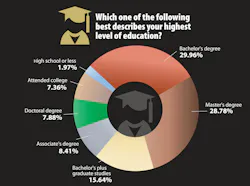
For our overall EDA group, doctorates are also well down from 2024 levels: they’re at about 8% vs. 12% last year. But among MWRF’s readers, the number is significantly higher at almost 17.5% of respondents. We already knew that RF engineers are a smart group, but here’s proof.
Still an Abundance of Continuing Education Options
If you’ve managed to find time and resources with which to further your education in 2025, you had quite a few options to choose from. What were the ways in which you collectively refreshed your engineering knowledge base (Fig. 2)?
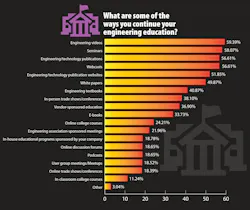
As usual, we’ve asked about your use of various modes of education. In this year’s survey, the most popular was engineering videos; nearly 60% of you use these educational tools, while about 58% take advantage of in-person seminars. For MWRF’s audience, engineering videos were even more popular, coming in at almost 72%. Seminars were also hot among MWRF fans at over 65%.
More than 56% read engineering/technology publications and a similar amount follow webcasts. Just shy of 52% of respondents visit websites associated with such publications (no change from last year). The business-to-business (B2B) media industry, including Microwaves & RF and its parent company Endeavor Business Media, produce quite a few print and/or online publications with a large amount of technical content that addresses a wide range of industries, including the electronics OEM.
Almost 50% of respondents make use of industry-generated white papers, a perennial source of information. Then there are engineering textbooks, an option that obviously comes at a cost, but still popular at nearly 41%.
That leads into the next tier of preferences in continuing-education options, led by in-person trade shows and conferences at about 38%. Vendor-sponsored education and eBooks came in at about 37% and near 34%, respectively. It’s worth noting that eBooks are often free of charge. A selection of those, as well as a great deal of exclusive and free content, can be found on MWRF’s Members Only page (requires site registration).
The bottom tier of preferences in continuing education spans online college courses (~24%), meetings sponsored by engineering associations (~22%), and a raft of options in the 18% ballpark. The latter includes employer-sponsored in-house meetings, online discussion forums, podcasts, user group meetings, online trade shows, and in-classroom college courses. The low ranking of podcasts is surprising, given that they’re typically free for the asking (or registering on the hosting site).
Tepid Interest in In-Person Learning Options
With the exceptions of seminars and trade shows/conferences, the overall popularity of in-person education options is generally low. One might think that in an age of fewer job opportunities, such gatherings represent prime venues for networking.
Nonetheless, events like user group meetings fall into that lower tier of education options. These informal meetups can be great for exchanging ideas, making those elusive career connections, or fostering working relationships. In-person college courses have dropped to 11% this year vs. over 12% last year. That might help explain the slight rise in attendance for online courses, which rose to 24% in 2025 from 22% in 2024.
How Employers Reimburse Learning Costs
While many educational options are free of charge, others are not. We would like to hope that our employers might at least help with those costs; after all, they stand to reap the benefits of better-educated employees. Alas, over 26% of you say you get nothing for your efforts (Fig. 3). That’s up slightly over 2024’s ~25%. For MWRF’s audience, the picture is even worse — almost 32% checked off “no reimbursements for continuing education.”
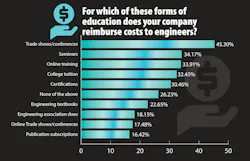
When employers are inclined to reimburse for continuing-education costs, their preferences are trade shows/conferences (over 45%), seminars (~34%), and online training (~34%). College tuition and professional certifications are both in the 30% to 32% range. For other education options, the picture is, unfortunately, dismal.
Time is the Enemy of Education
In each year’s Salary & Careers survey, we ask for written responses on the topic of challenges in staying up to date with technology advances. The perennial problem is time, or the lack thereof. For some, the lack of time for education is compounded by the sheer volume of information to be sorted through.
There’s a new stumbling block to get over: This year’s survey is the first in which artificial intelligence (AI) has been cited as a hindrance. One respondent mentioned “staying away from idiotic AI,” while another believes that the torrent of new information is AI-driven. “I wish when they say, ‘learn about AI/machine learning (ML),’ they were generic in what they were going to cover, not about how a new AI/ML product is the best.”
As always, the pace of technology developments is simply too much for some to stay abreast of. “It’s a constantly changing environment,” said one respondent. “The newest thing only lasts a couple of weeks before the next new thing appears.” For another, it’s the evolution of technologies and related standards that is daunting. “You must work constantly to stay in the loop.”
It’s never been easy to keep up with the state of the art in electronic engineering, and perhaps it’s never been harder than it is now. Here’s hoping you’re able to maintain and expand your knowledge base sufficiently in 2026 to stay current.
About the Author
 David Maliniak
David Maliniak
Executive Editor, Microwaves & RF
I am Executive Editor of Microwaves & RF, an all-digital publication that broadly covers all aspects of wireless communications. More particularly, we're keeping a close eye on technologies in the consumer-oriented 5G, 6G, IoT, M2M, and V2X markets, in which much of the wireless market's growth will occur in this decade and beyond. I work with a great team of editors to provide engineers, developers, and technical managers with interesting and useful articles and videos on a regular basis. Check out our free newsletters to see the latest content.
You can send press releases for new products for possible coverage on the website. I am also interested in receiving contributed articles for publishing on our website. Use our contributor's packet, in which you'll find an article template and lots more useful information on how to properly prepare content for us, and send to me along with a signed release form.
About me:
In his long career in the B2B electronics-industry media, David Maliniak has held editorial roles as both generalist and specialist. As Components Editor and, later, as Editor in Chief of EE Product News, David gained breadth of experience in covering the industry at large. In serving as EDA/Test and Measurement Technology Editor at Electronic Design, he developed deep insight into those complex areas of technology. Most recently, David worked in technical marketing communications at Teledyne LeCroy, leaving to rejoin the EOEM B2B publishing world in January 2020. David earned a B.A. in journalism at New York University.