Air Force Research Lab Tests Viability of Rocket-Powered Deliveries

Special deliveries may soon be made by rocket-launched vehicles, with the aid of the U.S. Air Force. During a recent commercial rideshare launch from Cape Canaveral Space Force Station, the U.S. Air Force Research Laboratory (AFRL) assessed the point-to-point delivery capabilities of their Rocket Cargo project.
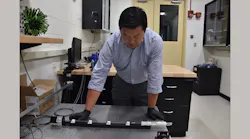
The experiment involved a SpaceX capsule designed for various loads and equipped with instrumentation to measure temperature, shock, and vibration (see image above). The capsule included a tracker to check the continuity of satellite communications during the voyage and throughout the capsule’s atmospheric re-entry.
AFRL commander General Douglas P. Wickert observed, “Any day you launch a rocket is a good day, but today was more than just another big rocket launch. Today's launch was another demonstration of how [the lab] is partnering with industry to [eliminate] risk, collect hard data, and deliver war-winning technologies for the operational force.”
The launch enabled AFRL to monitor payload integrity in flight and to determine potential capsule additions for trouble-free deliveries.
Adam Remaly, the AFRL’s Technology Transition Office director, noted, “This was a critical achievement to demonstrate the potential of Rocket Cargo delivery for point-to-point rapid global mobility for the future force. The cross-discipline collaborations and ability to unleash the speed of our defense industrial base are key to maximizing capability and winning the future.”
Learn more about the Air Force Research Laboratory
 Denewsjuly6 4 Promo

About the Author
Jack Browne
Technical Contributor
Jack Browne, Technical Contributor, has worked in technical publishing for over 30 years. He managed the content and production of three technical journals while at the American Institute of Physics, including Medical Physics and the Journal of Vacuum Science & Technology. He has been a Publisher and Editor for Penton Media, started the firm’s Wireless Symposium & Exhibition trade show in 1993, and currently serves as Technical Contributor for that company's Microwaves & RF magazine. Browne, who holds a BS in Mathematics from City College of New York and BA degrees in English and Philosophy from Fordham University, is a member of the IEEE.
Related



 Leaders Logo
Leaders relevant to this article: