Navy Refuels Unmanned Surface Vehicle at Sea with No Human Help
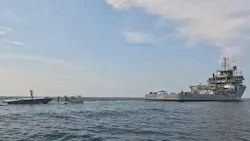
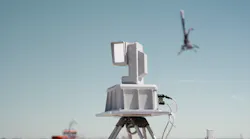
Seeking uncrewed operations for key functions at sea, the U.S. Navy completed a recent demonstration to refuel an unmanned surface vehicle (USV) with a robotic towed connector. Executed by the U.S. Naval Air Warfare Center Weapons Division in waters off the coast of Virginia, the demonstration repeatedly captured, refueled, and released a T38 USV at sea working with industry partners (see image above).
The contracting partnership boosted the warfare center’s Blue Water Instrumentation program and provided insight into how robotic refueling could help USVs remain in service when needed for longer periods of time. The refueling demonstration occurred only seven months following its initial conceptualization.
According to Spencer Holloway, director of the Blue Water Instrumentation program's future capabilities office, “Our immediate focus is supporting hypersonic and precision long-range fires testing, where flight profiles can extend thousands of miles beyond fixed-range boundaries and require data-collection assets to be distributed across a vast area.”
He pointed out the importance of refueling USVs, “But the underlying challenge applies more broadly — every time an unmanned vessel must return to port for fuel, we lose persistence, reduce coverage and redundancy, and interrupt the mission.”
During the demonstration, a U.S.N.S. Vindicator training support vehicle towed the refueling system and transferred a total of 400 gallons of fuel to the T38. Over the course of a few days leading up to and including the demonstration, the refueling system completed about 100 connection cycles.
Ronald Raymer, branch head for capability, innovation, science, and technology integration at U.S. Fleet Forces Command, also took part in the refueling demonstration. He noted that uncrewed refueling can strengthen fleet readiness, “This will allow us to have greater reliance on unmanned vessels ... and we can push the USV into higher threat areas without risking manned vessels and personnel.”
He added that it also represents a cost-effective solution. “It will also allow us to distribute greater capability into an area without having to invest in large, expensive manned vessels, and the refueling supports that.”
Learn more about unmanned surface vehicle technologies
About the Author
Jack Browne
Technical Contributor
Jack Browne, Technical Contributor, has worked in technical publishing for over 30 years. He managed the content and production of three technical journals while at the American Institute of Physics, including Medical Physics and the Journal of Vacuum Science & Technology. He has been a Publisher and Editor for Penton Media, started the firm’s Wireless Symposium & Exhibition trade show in 1993, and currently serves as Technical Contributor for that company's Microwaves & RF magazine. Browne, who holds a BS in Mathematics from City College of New York and BA degrees in English and Philosophy from Fordham University, is a member of the IEEE.
Related
 Leaders Logo
Leaders relevant to this article: