Blue Ops, Kymeta Team for Enhanced USV Communications

Kymeta has entered a partnership with Blue Ops to enhance the communications capabilities of the latter’s Variant 7 maritime uncrewed surface vessels (USVs). The teamwork will enable Kymeta’s low-power communications technology to support complex, secure control of autonomous USVs at greater distances and under more hostile operating conditions.
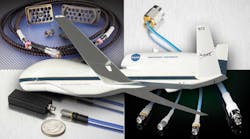
Kymeta’s systems integrate satellite and cellular communications networks to provide a backbone for beyond line-of-site (LOS) communications with autonomous maritime vehicles (see image above) in dense signal environments. They can integrate geosynchronous-Earth-orbit (GEO), low-Earth-orbit (LEO), and medium-Earth-orbit (MEO) satellite networks to provide uninterrupted communications links.
Manny Mora, CEO and president of Kymeta, explained, “Our technology is designed to deliver resilient, on-the-move connectivity across multiple networks in LEO, MEO, and GEO, and integrating it into Blue Ops’ Variant 7 enables persistent command and control for distributed USV operations. This collaboration is about ensuring operators can rely on real-time data and coordination, even in the most challenging conditions.”
Barry Hinckley, president of Blue Ops for Red Cat’s maritime division, noted, “As uncrewed surface vessels take on more complex and distributed missions, reliable connectivity becomes a critical enabler for coordinated operations, including swarming and real-time data sharing.”
Regarding the teamwork with Kymeta, Hinckley said, “Integrating Kymeta’s technology into our Variant 7 platform allows us to support these emerging capabilities and deliver USVs that can operate with greater range, coordination, and effectiveness in maritime environments.”
Learn more about uncrewed systems comms



About the Author
Jack Browne
Technical Contributor
Jack Browne, Technical Contributor, has worked in technical publishing for over 30 years. He managed the content and production of three technical journals while at the American Institute of Physics, including Medical Physics and the Journal of Vacuum Science & Technology. He has been a Publisher and Editor for Penton Media, started the firm’s Wireless Symposium & Exhibition trade show in 1993, and currently serves as Technical Contributor for that company's Microwaves & RF magazine. Browne, who holds a BS in Mathematics from City College of New York and BA degrees in English and Philosophy from Fordham University, is a member of the IEEE.