Maritime Users Envision Secure Laser Communications
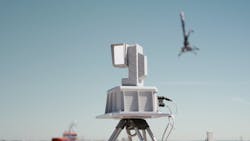
French shipbuilder Naval Group and Lithuanian optical technology company Astrolight signed a memorandum of understanding (MoU) to collaborate in testing Astrolight’s POLARIS free-space-optical (FSO) laser terminal on Naval Group’s ships as a means of overcoming hostile jamming efforts.
The narrow light beams employed in jam-resistant laser communications systems such as POLARIS (see image above) are difficult to detect and block. Thus, they enable secure communications at wide bandwidths and high data rates.
Naval Group is in the process of designing a multipurpose vessel for the Lithuanian Navy, the Multi-Purpose Offshore Patrol Vessel, and plans to install POLARIS onboard the ship for evaluation. The vessel will be capable of a variety of tasks, including combat, troop transport, launching uncrewed aerial vehicles (UAVs), and serving as a floating hospital.
Regarding the use of laser technology, Laurynas Maciulis, CEO of Astrolight, said, “With the growing threat of electronic warfare at sea, especially in the Baltic, Europe needs ships that can operate reliably in these challenging conditions.”
Concerning their laser-based systems, he noted, “Our interference-resilient laser technology, already successfully tested by NATO and the Lithuanian Navy, provides a secure way to communicate in the most challenging environments. Working with the Naval Group is an exciting step towards establishing laser-based communication as a new standard in European naval security.”
Simon Blanc, International Procurement and Cooperation Manager at Naval Group, remarked, “We’re excited to have Astrolight on board for the Lithuanian Navy’s new ship.” He added, “Together, we aim to provide Lithuania with a comprehensive, jam-resistant communication solution for the Baltic Sea and strengthen European defense capabilities.”
Astrolight’s POLARIS laser terminal has been successfully tested with the Lithuanian Navy, as well as at NATO’s REPMUS/Dynamic Messenger, an exercise focusing on maritime uncrewed vehicles.
Learn more about laser communications


About the Author
Jack Browne
Technical Contributor
Jack Browne, Technical Contributor, has worked in technical publishing for over 30 years. He managed the content and production of three technical journals while at the American Institute of Physics, including Medical Physics and the Journal of Vacuum Science & Technology. He has been a Publisher and Editor for Penton Media, started the firm’s Wireless Symposium & Exhibition trade show in 1993, and currently serves as Technical Contributor for that company's Microwaves & RF magazine. Browne, who holds a BS in Mathematics from City College of New York and BA degrees in English and Philosophy from Fordham University, is a member of the IEEE.