Framework Agreements Feed Defense System Supply Chains
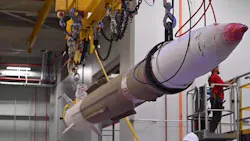
The U.S. Department of War (DoW), working with Northrop Grumman and Lockheed Martin, established two framework agreements to ensure long-lasting supply-chain support. The agreements enable production capacity increases for two major defense programs, the Patriot Advanced Capability-3 (PAC-3) Missile Segment Enhancement (MSE) system and the Terminal High Altitude Area Defense (THAAD) program. The agreements contribute to strengthening U.S integrated air and missile defense systems.
For the PAC-3 MSE, the agreement establishes a second source for solid rocket motors (SRMs), injecting stability and competition into the supply chain for SRMs (see image above). It also boosts production of PAC-3 ignition safety devices. For the THAAD program, the agreement makes it possible to quadruple the production of THAAD interceptor structural components.
Regarding the agreements, Michael P. Duffey, Under Secretary of War for Acquisition and Sustainment, said, “Building the Arsenal of Freedom requires robust, dynamic supply chains at every level of the industrial base. Framework agreements with munition components suppliers like Northrop Grumman are vital to accelerating the tripling of PAC-3 and quadrupling of THAAD interceptor production.”
Learn more about missile defense systems

 Missile
About the Author
Jack Browne
Technical Contributor
Jack Browne, Technical Contributor, has worked in technical publishing for over 30 years. He managed the content and production of three technical journals while at the American Institute of Physics, including Medical Physics and the Journal of Vacuum Science & Technology. He has been a Publisher and Editor for Penton Media, started the firm’s Wireless Symposium & Exhibition trade show in 1993, and currently serves as Technical Contributor for that company's Microwaves & RF magazine. Browne, who holds a BS in Mathematics from City College of New York and BA degrees in English and Philosophy from Fordham University, is a member of the IEEE.