Berkeley Nucleonics Model 686 AWG combines 20 GS/s sampling with wideband RF, IF and I/Q signal generation
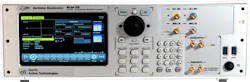
14-bit architecture provides 5.8 GHz measured bandwidth, 6.5 GHz sine generation, deep waveform memory and multi-instrument synchronization
SAN RAFAEL, Calif. (October 12, 2026) Berkeley Nucleonics Corporation (BNC) presents the Model 686, a high-speed arbitrary waveform generator for wideband RF, IF and I/Q signal generation. The Model 686 combines 14-bit vertical resolution with sample rates up to 20 GS/s, up to 9 Gpts of waveform memory and two- or four-channel analog configurations.
In True Arb operation, the Model 686 has a measured 3 dB bandwidth of 5.8 GHz. Single-ended configurations provide output amplitudes up to 5 Vpp, while differential models provide up to 2.5 Vpp differential. True Arb rise and fall times are 50 ps or less for single-ended models and 45 ps or less for differential models (20% to 80%, 1 Vpp single-ended).
AFG mode extends sine-wave generation to 6.5 GHz, giving engineers a single platform for conventional RF stimulus as well as complex arbitrary waveforms.
“Modern communications and radar systems place increasingly complex demands on modulation and timing, creating significant challenges for RF engineers to accurately reproduce those signals,” said John Lauder, Chief Technical Officer at Berkeley Nucleonics. “The Model 686 delivers the high sample rate, extensive waveform memory, and synchronized channels required to generate these signals with precision and repeatability.
Deep memory and segmented waveforms
Up to 9 Gpts of waveform memory supports long signal records for applications in which frequency, amplitude, pulse spacing or modulation changes over time. True Arb mode builds a scenario from segments, each with its own repetition count and length, allowing engineers to assemble long, repeatable RF scenarios without storing every event as one continuous waveform.
For applications requiring additional outputs, up to four Model 686 instruments can be synchronized through a dedicated bus. A four-unit system can provide as many as 16 synchronized analog channels. Each instrument also provides up to 32 digital channels, for as many as 128 across a four-unit system.
RF, radar and electronic-warfare applications
The Model 686 can generate complex RF, IF and I/Q waveforms, pulsed RF signals, frequency-agile pulses and complex pulse trains. These capabilities support applications such as radar receiver testing, electronic-warfare threat emulation and other wideband RF test scenarios requiring controlled and repeatable stimulus.
Multi-channel synchronization also allows several coordinated waveforms to be applied to more complex test architectures while maintaining a common timing structure across the system.
Typical applications include:
- RF, IF and I/Q waveform generation
- Radar target and receiver testing
- Electronic-warfare signal and threat emulation
- Complex pulse and pulsed-RF generation
- Multi-channel RF test systems
- High-speed mixed-signal testing
For specifications, a quote or help configuring a Model 686 system, visit the Model 686 product page or contact Berkeley Nucleonics at [email protected] or (800) 234-7858.
Model 686 product page:
https://www.berkeleynucleonics.com/lp/awg-686/
About Berkeley Nucleonics Corporation
Berkeley Nucleonics Corporation (BNC) has been a trusted name in precision electronic instrumentation since 1963, serving defense, research, academic and industrial customers with digital delay generators, arbitrary waveform generators, RF/microwave signal generators, real-time spectrum analyzers, pulsed power systems and nuclear radiation detection equipment.
With more than 60 years of experience, BNC supports customers with configurable instrumentation, application expertise and responsive technical support.