Machine Vision for Cobots and Industrial Sensors
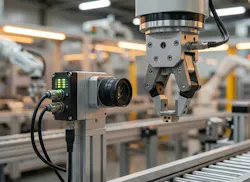
Machine vision pairs with conventional sensing to make cobots more flexible
Conventional automation performs well when each object arrives in a known position and the workspace stays consistent. However, when the consistency changes, a programmed movement can no longer suit the task. This challenge is being felt more in today’s automation environments as collaborative robots (cobots) enter applications where part placement, human activity, and working environments can constantly change.
A cobot can adjust if its control system receives enough information about what has changed. While confirmation that a part is present may be enough at a fixed loading point, this information provides less guidance when the part arrives in a different position or orientation. Therefore, machine vision adds information about the workspace to help cobot systems locate objects, identify visible features, and assess conditions before choosing their next action.
Our previous blog in this cobot series focused on the automation workflows that benefit most from cobot mobility. Here, we explore how machine vision differs from conventional sensing, how visual data enables cobots to adapt their motion, and the critical design challenges engineers must address when implementing these systems in production environments.
What Internal and External Sensors Tell the Cobot
Cobots already use many internal sensors to control their movement. But external sensors provide data about the surrounding environment and physical interaction. For example, a proximity sensor indicates whether an object has entered a defined range, while a photoelectric sensor detects an object through changes in received light.
Each sensor data point informs the cobot on a very specific aspect of position, presence, or contact. Cameras are also sensors, with imaging able to support several measurements across a scene. In the case of a 2D camera, it records light intensity and, with a color sensor, color information. Software analyzes this data to identify features and object position within the image plane.
3D vision systems add depth information. Software uses this information to estimate an object’s position and orientation in three-dimensional space. However, this estimate still depends on which surfaces are visible and how reliably the system measures them.
Simply adding more information does not make vision the best choice for every cobot. Sometimes, a proximity sensor can provide a more reliable presence check. Vision can estimate where contact should occur, but force sensing measures the actual interaction.
Therefore, complementary sensing assigns each method a clear role, where vision identifies and locates the object, internal feedback controls movement, contact sensors verify interaction, and safety-rated devices support protective functions.
Adaptive Navigation Uses Vision to Adapt the Robot’s Motion
In a scenario where different parts in an industrial factory are arriving at different positions and angles on a work surface, a fixed robot program expects each part at predetermined coordinates. If its placement changes, the programmed approach can miss the target. Vision enables the cobot to adjust its approach based on the observed position and orientation.
The workflow starts by capturing an image or 3D depth information. Next, software separates the objects from their backgrounds, identifies relevant features, and calculates the locations and orientations. A calibrated system converts this information into the robot’s coordinates.
For parts identified on a known plane, 2D vision can locate their position and planar rotation. Different characteristics like shape, color, labels, and edges can be useful for identification, while visible surface defects can be used for inspection. But when these parts vary in height, tilt, or overlap, 3D vision comes into play to add depth information required to understand the setup.
>>Read the entire article at Mouser