Machine Safety Best Practices in Industrial Automation
Key Highlights
- Risk assessment begins with hazard identification, evaluating severity and likelihood to determine necessary safety measures.
- Standards such as ISO 12100, IEC 61508, and IEC 62061 provide frameworks for implementing effective safety strategies in automation systems.
- Safety functions monitor critical inputs and automatically transition systems to safe states during hazardous conditions, often using redundant architectures.
On April 6, 2026 in All, Automation, Circuit Protection, Industrial, Industrial Automation, Robotics, Sensors by Abhishek Jadhav
Implement functional safety, risk assessment, and protective measures in automated systems
Source: Faisal/stock.adobe.com; generated with AI
The most critical requirement in an industrial plant, particularly those operating heavy machinery or complex automated systems, is a robust safety program. While modern automation brings significant productivity and efficiency benefits, it also introduces potential hazards to operators, maintenance personnel, and anyone working near automated equipment.
Effective machine safety in industrial automation requires a systematic approach that combines adherence to industry standards, comprehensive risk assessments, and the implementation of engineering safeguards. These safeguards must be integrated into machine design and control systems to minimize hazards while maintaining operational efficiency.
This blog explores machine safety best practices in industrial automation, outlining how risk assessment, functional safety standards, and safety- and performance-level targets guide the design of reliable safety functions. It also explains how common safety equipment and standards-based implementation helps protect personnel while maintaining system performance.
Steps to Implement Machine Safety
Implementing safety in an automation environment starts with a structured functional safety life cycle. This process includes identifying hazards, assessing risks, reducing those risks through engineered safeguards, and continually validating and maintaining machine safety.
International standards provide frameworks for implementing best practices. For instance, International Organization for Standardization (ISO) 12100 gives principles for machinery risk assessment and hazard reduction, while standards such as ISO 13849 and International Electrotechnical Commission (IEC) 62061 define requirements for safety-related control systems.[1] In process industries, IEC 61508 and IEC 61511 govern functional safety and safety instrumented systems (SIS), respectively.[2]
Assess Hazards and Risks
Risk assessment begins by identifying potential hazards associated with machinery or processes. These hazards may include mechanical risks (e.g., crushing or pinch points), electrical hazards from energized components, pneumatic or hydraulic pressure failures, or chemical and thermal hazards.
After identifying the hazards, engineers must evaluate the severity and likelihood of each to determine the required level of risk reduction. The objective is to determine whether additional safeguards are necessary and what type of safety function is required.
Standards like ISO 12100 and American National Standards Institute (ANSI) B11.0 guide this process for machinery safety.[3] For instance, a risk assessment might identify pinch-point hazards on a conveyor system, collision risks in robotic work cells, or overpressure conditions in a reactor vessel. This assessment is intended to determine which hazards require engineered protective measures.
Apply the Hierarchy of Controls
Risk mitigation follows the hierarchy of controls that prioritizes hazard-reduction methods by effectiveness. The preferred approach is to eliminate hazards or substitute safer alternatives during the design stage. If elimination is not possible, engineers must implement engineering controls to isolate operators from hazards. Engineering controls include physical guards, interlocks, safety circuits, and automated shutdown systems that can prevent an incident without relying on human intervention.
Design and Integrate Safety Functions
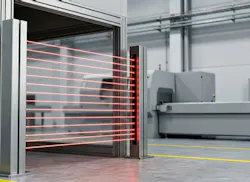
Once engineers have assessed the hazards, they must implement safety functions within the machine control systems to achieve the required level of risk reduction. Safety functions monitor critical inputs, such as guard position, emergency stop activation, or intrusion detection, and automatically transition the system to a safe state when hazardous conditions are detected.
These functions are implemented using safety-related control systems, which may include safety relays, safety programmable logic controllers (PLCs), or certified motion controllers. Safety functions are designed to be fail-safe, meaning that a fault condition (e.g., a wire break or power loss) causes the system to default to a safe state.
Reliability is increased through redundancy and diagnostics. For example, many safety circuits use dual-channel architectures with cross-monitoring, so that if one channel fails, the other can still trigger a stop.
>>Click to read the entire article at Mouser
[1] https://www.iso.org/standard/51528.html; https://www.iso.org/standard/73481.html; https://webstore.iec.ch/en/publication/59927
[2] https://assets.iec.ch/public/acos/IEC%2061508%20&%20Functional%20Safety-2022.pdf; https://webstore.iec.ch/en/publication/24241
[3] https://webstore.ansi.org/standards/amt/ansib112023
About the Author
Abhishek Jadhav
Abhishek Jadhav received his M.S. in Electrical and Computer Engineering and started his career as a technical writer. He has over five years’ experience working as a freelance technical writer, with key interests in power electronics and embedded systems. His work has appeared in EE Times, embedded.com, and Power Electronics News, among others.