How to Reduce Battery Dependence in Industrial IoT Devices
What you'll learn:
- The limits of battery-based architectures.
- Ambient light as a practical energy source.
- Using organic photovoltaic (OPV) technology for indoor energy harvesting.

Industrial IoT (IIoT) deployments continue to expand across applications such as smart buildings, asset tracking, and infrastructure monitoring. While wireless connectivity technologies are now mature and widely deployed, powering large numbers of distributed RF devices remains a key challenge.
In many deployments, devices rely on batteries designed to support operation over several years. However, as the scale of deployments increases, battery replacement introduces significant operational constraints. Maintenance costs, accessibility of devices, and system downtime become limiting factors, particularly in industrial environments where devices may be widely distributed or difficult to access.
Battery replacement also represents a significant portion of the total cost of ownership in large-scale deployments. For example, in a deployment of 25,000 sensors, maintenance costs associated with battery replacement could reach several million euros over the system's lifetime. As a result, power is increasingly treated as a system-level design parameter rather than a secondary consideration.
Limits of Battery-Based Architectures
Battery-powered designs offer simplicity and predictable performance. But they require systems to be sized around total energy capacity, often leading to oversized storage relative to actual device needs.
At scale, this model creates recurring maintenance cycles. Even with multi-year battery life, large deployments can require continuous replacement operations. This impacts operational costs and introduces potential points of failure.
In addition, batteries often represent a significant portion of device size, limiting form-factor flexibility and increasing material usage. In many low-power IoT devices, the battery is one of the largest components in the system.
Power Consumption in Low-Power RF Devices
Low-power RF devices, such as those using Bluetooth Low Energy (BLE) or similar wireless protocols, typically operate by remaining in sleep mode most of the time and waking periodically to transmit data (Fig. 1).
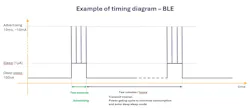
This results in very low average power consumption, with short bursts of higher energy use during RF transmission. Because energy usage is intermittent rather than continuous, these devices can operate with relatively small amounts of energy, provided it’s available when needed.
This operating model is consistent with many ultra-low-power systems, which remain in sleep mode most of the time. It consumes microampere to nanoampere quiescent currents and periodically wakes to sense and transmit data at milliampere levels for very short periods (ms).
From Energy Storage to Energy Availability
Traditional battery-based systems are designed around stored energy capacity. The goal is to ensure that enough energy is available to support operation over a defined lifetime.
Energy harvesting introduces a different approach. Instead of relying solely on stored energy, systems can be designed around continuous energy availability. In this model, energy is generated in the environment and accumulated over time, then used during periods of device activity.
Rather than sizing systems based on total lifetime energy capacity, designers can evaluate how much energy is required for reliable operation and how quickly that energy could be replenished. This shift allows for significantly reduced storage requirements, as energy is continuously replenished rather than consumed from a fixed reserve.
Ambient Light as a Practical Energy Source
Many IIoT devices operate indoors, where ambient light is consistently available, although at lower levels than outdoor sunlight. Typical indoor lighting conditions range from approximately 400 to 1,000 lux. By comparison, outdoor daylight can reach 10,000 to 100,000 lux, making indoor environments significantly more challenging for traditional photovoltaic technologies.
Under those conditions, conventional photovoltaic technologies aren’t always optimized. Technologies designed specifically for low-light environments are better suited to efficiently convert available light into usable electrical energy.
Organic photovoltaic (OPV) technology is designed to harvest energy from ambient light, particularly in indoor environments. It converts low levels of light into electrical energy that’s able to power low-power electronic systems. OPV modules generate energy continuously when exposed to light and can be designed to match specific voltage and current requirements. The voltage delivered depends on the number of cells connected together, with individual cells typically providing around 0.6 to 0.7 V.
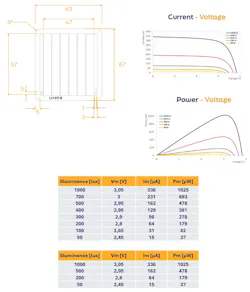
Performance depends on the available illumination level. For example, under an illuminance of 200 lux, an OPV module (six cells) with an active area of 47 × 57 mm can generate approximately 2.8 V and 64 µA, corresponding to an output power of about 179 µW. Higher output power can be achieved at increased illumination levels.
The performance values shown in Figure 2 depend on the active surface area of the OPV module. OPV modules can operate in very low-light conditions, generating energy at illumination levels as low as 50 lux and even down to 5 lux. Because energy is generated continuously, it can be accumulated in a small storage element and used to support periodic device activity, including RF communication.
Combining OPV with RF Systems
The combination of OPV energy harvesting with low-power RF communication enables a new class of wireless devices designed for reduced maintenance and extended operational lifetimes.
In this approach:
- OPV provides a continuous source of energy from ambient light.
- Energy is stored locally in a compact storage element.
- The RF device operates intermittently, using stored energy to transmit data.
This alignment between energy generation and RF consumption leads to systems that can operate autonomously over long periods without frequent battery replacement. In addition, this approach will support the development of hybrid wireless tags and sensors. These devices combine RF communication capabilities with energy harvesting, enabling enhanced functionality compared to passive systems while reducing dependence on batteries.
Dracula Technologies is currently working with partners on such hybrid tag architectures, exploring how energy harvesting can extend device capabilities and operational lifetime in real-world applications. Recent industry developments are also exploring hybrid approaches that combine multiple energy-harvesting and wireless power technologies to improve system reliability and deployment flexibility.
For example, Powercast recently introduced its EDGE platform for scalable wireless power infrastructure targeting AI-driven edge systems. As part of this ecosystem approach, Powercast is collaborating with Dracula Technologies on battery-free BLE sensor nodes combining RF wireless power with Dracula’s LAYER organic photovoltaic technology.
In this architecture, OPV provides complementary energy harvesting from ambient indoor light in environments where RF energy availability may vary, helping support the continuous operation of low-power wireless devices.
These hybrid approaches illustrate how combining localized ambient energy harvesting with wireless power delivery can help reduce battery dependence while improving operational continuity in large-scale IIoT deployments.
System Integration Considerations
Integrating energy harvesting into RF systems requires coordination between several elements:
- Energy generation (OPV)
- Energy storage (capacitor, thin battery, or integrated storage layer)
- Energy management (voltage regulation and control)
- RF device consumption
In some cases, energy storage could be integrated directly with the energy-harvesting module. For example, an integrated storage layer can provide sufficient capacity to support device operation without requiring a separate battery or capacitor.
Energy-management circuitry may be required depending on the application. Some low-power systems can operate without a dedicated power-management IC, while others require regulation and optimization to ensure stable operation under varying light conditions. The performance of the overall system depends on how well these elements are matched to each other and to the operating environment (Fig. 3).
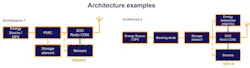
Architecture 1: With the PMIC, the OPV continuously harvests energy from ambient light. The harvested power is processed by an energy-harvesting PMIC that:
- Performs impedance matching or MPPT (maximum power point tracking).
- Boosts low OPV voltage during cold start.
- Manages charging of the storage element.
- Regulates the supply voltage for the RF SoC.
The storage element acts as an energy buffer, allowing the BLE system to operate during low-light periods or transmission peaks. Typical storage technologies include rechargeable thin-film battery, Li-ion microbattery, solid-state battery, supercapacitor.
Architecture 2: Without the PMIC, the OPV directly charges the storage element through a blocking diode, preventing reverse-current leakage during dark conditions. The RF SoC is powered directly from the storage node. Since no active PMIC regulates the supply voltage, the system voltage dynamically follows the storage element voltage. As a result, the RF SoC and optional sensor ICs must support a wide operating voltage range and tolerate supply voltage variations.
The RF device, therefore, needs:
- Hardware brownout monitoring
- Voltage-aware firmware or software
- Adaptive duty cycling
The Move Toward Scalable, Low-Maintenance IoT systems
As IIoT deployments continue to grow, reducing maintenance requirements becomes a key objective. Powering strategies that reduce battery dependence can significantly improve scalability and operational efficiency.
Energy harvesting from ambient light provides a practical approach for powering low-power RF devices in many indoor applications. By aligning energy generation with device operation, engineers can design systems that operate reliably with reduced need for manual intervention.
Advances in manufacturing also support the large-scale deployment of these technologies. OPV modules can be produced using printing processes that enable high-volume manufacturing and customization of form factors to match specific device requirements. This evolution supports the development of more autonomous, scalable, and lower-maintenance IIoT systems.