Can GaN-on-Si Meet Changing Needs in Military and Commercial RF Amplifiers?
What you'll learn:
- Why software-defined radios are forcing a rethink of RF power amplifiers.
- SDRs will replace legacy repeaters with agile, multi-band small cells.
- GaN-on-Si will serve future generations of tactical communications.
In 2026, the modernization of military and government tactical communications is being shaped by a powerful technological convergence: the blending of traditional ruggedized radio systems with commercial broadband small-cell technology. This shift is unified under the flexible architecture of software-defined radio (SDR).
As military and government safety operations demand greater mobility, higher data throughput, and improved network adaptability, the limitations of legacy systems are becoming stark. Legacy narrowband radios are now giving way to SDR-based platforms capable of supporting a vast range of waveforms — from legacy TETRA, DMR, and P25 to modern OFDMA standards — all within a single, reconfigurable system.
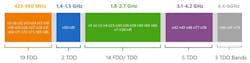
This transition requires hardware that can span an impressive frequency range, covering more than 40 LTE bands below 6 GHz (see figure). To fully realize the potential of this architectural shift, not only must there be an evolution in the RF front-end topology, but also in the underlying technologies, especially in the RF power amplifier space.
The Tactical Edge: Small Cells and Multi-Band Repeaters
The modernization of tactical networks extends beyond the individual soldier's handset. To ensure reliable connectivity in contested or obstructed environments, such as urban canyons or ship interiors, the infrastructure itself must undergo an evolution. This drives the convergence of military specifications with commercial small-cell and repeater technology.
Legacy repeaters were often static, single-band “dumb pipes,” capable of amplifying only a specific frequency range (e.g., UHF or L-band). In the modern SDR paradigm, these fixed nodes are being replaced by agile, multi-band small cells and repeaters having the following attributes:
- Spectrum agility: By leveraging the same SDR architecture as the handheld units, modern repeaters can dynamically reconfigure across the spectrum from 420 MHz to 6 GHz. As a result, a single piece of hardware can serve as an LTE small cell at one moment and a legacy P25 relay the next, adapting instantly to mission needs.
- Cross-banding capabilities: SDR-based repeaters enable "cross-banding," which implies receiving a signal at a lower frequency (for better penetration) and re-transmitting it on a higher frequency (for capacity), seamlessly bridging disparate networks.
- Hardware unification: This convergence means the RF front-end challenges apply universally. Whether for a portable radio or a tactical small-cell repeater, the hardware must handle the same wider bandwidths and complex waveforms, reinforcing the need for the advanced amplification technologies discussed in the next section.
GaN-on-Si Will Bring Convergence to RF Amplification
New generations of multi-band, multi-standard SDR systems require broadband, highly linear amplifiers capable of maintaining performance across all LTE and tactical frequency bands. Broadband power amplifiers (PAs) based on gallium-nitride (GaN) technology have become critical enablers of this transformation.
Unlike legacy silicon technologies, GaN is a “wide bandgap” semiconductor whose intrinsic properties offer superior efficiency, power density, and thermal reliability. These characteristics allow a single amplifier chain to support relatively wider frequency coverage while delivering the linearity and output power required for modern broadband waveforms.
To modernize tactical communications at scale, engineers have three distinct RF power transistor technologies available: LDMOS (high- or low-resistivity silicon substrate), GaN-on-SiC (silicon carbide substrate), and GaN-on-Si (high-resistivity silicon substrate).
1. LDMOS: A Legacy Technology
Laterally diffused metal-oxide semiconductor (LDMOS) has been the workhorse technology for RF amplification for decades due to its low cost, competitive performance, and mature processes. For many years, LDMOS has enjoyed a monopoly as a cellular base station power-amplifier technology of choice. This has allowed its development to accelerate over that period, resulting in widespread adoption.
However, the two leaders in legacy LDMOS — Infineon and NXP — have committed to end-of-life (EoL) for their products, leaving Ampleon as the sole remaining option. This has been attributed to poor demand and a less desirable fit for upcoming applications.
2. GaN-on-SiC: The Costly Performance Leader
Growing GaN crystals on a silicon-carbide (SiC) substrate creates the ultimate high-performance transistor technology. Because GaN transistors with high power density dissipate a large amount of heat in a small area (compared to LDMOS), the substrate technology plays an important part in heat removal. SiC is an excellent thermal conductor (3X better than silicon), enabling GaN-on-SiC devices to handle extreme heat and power density.
GaN-on-SiC is best used in high-power wideband radar, electronic-warfare (EW) jamming pods, and static macro base stations where cooling is managed and cost is secondary. However, SiC substrates are incredibly expensive and difficult to manufacture in large diameters (typically limited to 4- to 6-in. wafers). This keeps the cost per die area high, making it expensive to deploy in every soldier's handheld radio or in disposable drones, even though its performance can be the best among other technologies.
3. GaN-on-Si: The Strategic Convergence Solution
For widespread military modernization, GaN-on-Si has emerged as a solution. By growing GaN epitaxial layers on standard silicon wafers, manufacturers can process these chips in standard CMOS foundries using large-diameter (8 or 12 in.) wafers.
This year, for the first time, at least two major open foundries are offering RF GaN-on-Si processes for both design and production ramp-up. We will start seeing more products brought to the market leveraging these new nodes. The technology promises to have similar electrical performance as GaN-on-SiC because it uses nearly the same epitaxial structure, resulting in comparable device parameters. It is, however, operated at lower voltages to keep power dissipation manageable.
GaN-on-Si Poised to Serve Tactical SDR
For several reasons, GaN-Si is in position to serve the next generations of tactical SDR communications. For one, it leverages the global silicon supply chain, reducing costs to near-LDMOS levels while offering near-SiC performance. This makes it economically viable to put high-end broadband amplifiers in thousands of portable units.
For another, because the substrate is standard silicon, it opens the door to monolithic integration. Future designs can include the GaN PA and digital front-end (DFE) control logic on the same die, drastically reducing the physical footprint. This is a critical factor for gear constrained by size, weight, and power (SWaP) concerns.
Finally, there’s thermal performance: The power density of GaN-on-Si is roughly the same as GaN-on-SiC (for a given VDS). While silicon is less thermally conductive than SiC, modern device thinning and layout techniques have closed the gap, allowing GaN-on-Si to easily handle the typical 5- to 50-W output power levels of handheld units and small cells.
About the Author
 Michael Guyonnet
Michael Guyonnet
VP Marketing, Finwave Semiconductor
Michael Guyonnet joined Finwave two years ago as VP Marketing & Applications, following various technical and marketing leadership roles at Renesas, Ampleon, MACOM, and NXP. He began his career as a design and modeling engineer at Motorola/Freescale and holds a PhD and a Master’s degree from the Université de Limoges in France.
 Hussain Ladhani
Hussain Ladhani
Senior Staff Engineer, Finwave Semiconductor
Hussain Ladhani is an experienced Senior Staff Level RFIC/PA Module Design Engineer with a specialized focus on RF power-amplifier design at both board and MMIC levels. Throughout his career, he has successfully executed designs ranging from 1 to 400 W, spanning frequencies from 500 MHz to 5 GHz using GaN and LDMOS technologies for the wireless communication market.
Related
 Leaders Logo
Leaders relevant to this article: