Thermal Gel Helps Dissipate Circuit Heat
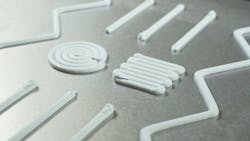
A versatile and flexible thermal interface material helps reduce the heat and hot spots within printed-circuit boards (PCBs) and systems with heat-generating components, such as radars with high-power amplifiers. Developed by the Chomerics Div. of Parker Hannifin Corp., THERM-A-GAP GEL 120 is a single-component solution for dissipating heat at critical thermal junctions within electronic systems. The gel features thermal conductivity of 12.0 W/m-°K to draw heat away from thermal sources and protect surrounding circuits, materials, and components. It is well suited for filling air gaps of typically less than 0.5 mm to as wide as 4.0 mm and other tight spaces in which excess heat can lead to damaging thermal expansion and contraction.
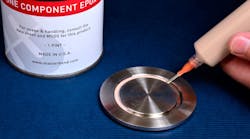
The one-component thermal gel does not require secondary curing or treatment and can be applied with low compressive force to fit tight spaces while placing minimal stress on surrounding components and solder joints. It is a fit for commercial, industrial, and mission-critical military applications. The gel functions effectively at operating temperatures from -50 to +200°C. As an integral part of automated manufacturing programs, the thermal gel can be applied with robotic dispensing machines at a flow rate of 25 g/min. The RoHS-compliant material features dielectric strength of 5 kVAC/mm with a dielectric constant (k) of 5.7 for 2-mm thickness measured at 1 MHz. The dissipation factor (Df) is 0.013 for a 2-mm thickness measured at 1 MHz. The material is available in a variety of formats, including in a syringe, plastic container, and bucket (see figure).
Learn more about thermal management

About the Author
Jack Browne
Technical Contributor
Jack Browne, Technical Contributor, has worked in technical publishing for over 30 years. He managed the content and production of three technical journals while at the American Institute of Physics, including Medical Physics and the Journal of Vacuum Science & Technology. He has been a Publisher and Editor for Penton Media, started the firm’s Wireless Symposium & Exhibition trade show in 1993, and currently serves as Technical Contributor for that company's Microwaves & RF magazine. Browne, who holds a BS in Mathematics from City College of New York and BA degrees in English and Philosophy from Fordham University, is a member of the IEEE.