Durable Stacking/Nesting Connectors Accelerate Design of Unmanned Craft
The Overview: Stacking/Nesting Interconnects for UGVs, USVs, and UAVs
Whether on land, sea, or air, Samtec’s UxV/35-FleXYZ ESQT series of durable interconnect systems is designed to stack and nest, forming a vertical 35-pin bus that adjusts to different design sizes and configurations.
Who Needs It & Why: Plug & Play for Unmanned-Craft Integrators
The UxV/35 standard supports fast-track, small, unmanned craft designs by providing compatible, open-source flight and vehicle control with snap-together systems and minimal wiring. The standard includes guidance on connector definitions, PCB design/layout, electrical interfaces (pin mapping), stackable bus architecture, power-distribution frameworks, and module definitions.
These connectors support the RMS Consortium’s UXV/35 standard for small, unmanned craft. The devices are purpose-made for use in small, unmanned craft, including unmanned ground vehicle (UGV), unmanned surface vehicle (USV; water), and unmanned aerial vehicle (UAV) designs for military or commercial use.
Modules can be combined to function in application-specific configurations, such as flight controllers, electronic speed controls (ESCs), power distribution, and communications.
Under the Hood: A Vertical Bus That Adjusts to Fit Requirements
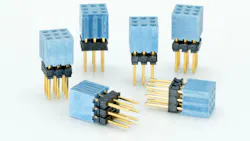
The UxV/35-FleXYZTM ESQT series interconnects are based on a 2-mm grid with a 3×3 pin configuration. Because these connectors stack and nest, they can be used to form a vertical bus that adjusts to different design sizes and configurations. Specifically, the series comprises 9- and 8-pin connectors with either long- or short-pin configurations. Designers combine three 9-pin connectors with one 8-pin connector that acts as a keying guide for assembly, creating a 35-pin bus.
To help indicate that they're U.S.-sourced, the connectors feature a distinctive blue housing. Test reports, including power integrity, severe environmental, and solder heat resistance testing, as well as prints and PADS, files are available on the Samtec product page.
Learn more about RF interconnects



About the Author
 David Maliniak
David Maliniak
Executive Editor, Microwaves & RF
I am Executive Editor of Microwaves & RF, an all-digital publication that broadly covers all aspects of wireless communications. More particularly, we're keeping a close eye on technologies in the consumer-oriented 5G, 6G, IoT, M2M, and V2X markets, in which much of the wireless market's growth will occur in this decade and beyond. I work with a great team of editors to provide engineers, developers, and technical managers with interesting and useful articles and videos on a regular basis. Check out our free newsletters to see the latest content.
You can send press releases for new products for possible coverage on the website. I am also interested in receiving contributed articles for publishing on our website. Use our contributor's packet, in which you'll find an article template and lots more useful information on how to properly prepare content for us, and send to me along with a signed release form.
About me:
In his long career in the B2B electronics-industry media, David Maliniak has held editorial roles as both generalist and specialist. As Components Editor and, later, as Editor in Chief of EE Product News, David gained breadth of experience in covering the industry at large. In serving as EDA/Test and Measurement Technology Editor at Electronic Design, he developed deep insight into those complex areas of technology. Most recently, David worked in technical marketing communications at Teledyne LeCroy, leaving to rejoin the EOEM B2B publishing world in January 2020. David earned a B.A. in journalism at New York University.