The Search for 6G (or Spock)
What you'll learn:
- Why expecting 6G by 2030 is unrealistic.
- What technologies will be needed to launch real 6G, at spec.
- What are the global and technical issues 6G has to overcome.
- Why the current discussions around 6G aren’t realistic.
Any sci-fi aficionado, over 40, and the many younger Trekkies, know the myriad of spun-off series and movies spawned from the immortal original Star Trek series. For this discussion, I’m referring from a metaphorical perspective to the movie The Search for Spock.
I’ve been writing about 6G for several years now. Many of my ruminations revolve around the hype that’s common whenever new telecom or other technology advances bubble up to the surface.
Today I read an analyst’s opinion that talked about 6G reaching a halfway point in its life. That implies we will have 6G by 2030, which seems to be a common thread lately in many of today’s 6G discussions.
I wonder if this 2030 target is more of a reassurance narrative than fact-based. I’m not convinced that 6G will be here by then. However, as was the case with 5G, there may be some early 6G-“like” services (such as was 5G non-standalone, NSA) so that the industry can claim accuracy on the predictions and keep the dream alive.
Depending on how one reads the analyst’s and forecaster’s numbers, for the current 5G ecosystem, one can come away with just about any conclusion one wants. And much of this data is in the form of either market dollars, connections, or operators that have launched 5G standalone (5G SA).
But the fact is that when one peels away the above criterion, 5G SA is only deployed in about 21% of the global wireless infrastructure. So, is this just a ramp-up of new hype?
Let’s step back for a moment. There’s also a slice of this industry that questions what 6G will be. Some say it will simply add the functions and performance promised with 5G, which isn’t anywhere near delivering the performance promised in the early hype, even with greenfield deployments. And many who aren’t in the marketing segment have argued that 5G is really nothing more than the evolution and maturation of 4G, with 6G being the true next generation. I tend to agree.
5G Stats and the Promise of 6G
Currently, the fastest 5G network speed globally is just over 400 Mb/s. The median is about 388, up about 20% from 2024 (from Ookla). Latency is 5 to 10 ms. This fifth generation originally promised 10-Gb/s speeds and 1-ms latency. So, the truth is we’re way below hyped stats for 5G.
Performance for 6G is promised at 1 THz with less than 1-ms latency. A couple of controlled 6G experiments at millimeter-wave (mmWave) spectrum have seen a speed of 100 Gb/s; one eclectic university lab setup managed 900+ Gb/s (using lasers and the W- and D-band GHz frequencies, not a real-world situation). Latency wasn’t given and the distance between the devices was under 100 meters. While this may be early proof-of-concept (PoC), it hardly qualifies as anything near real-world.
These numbers are why I question that 6G will be here by 2030 (maybe initial deployments in 2035, but likely 2040+ for standalone).
However, a ton of mitigating conditions, mostly as new technologies, are introduced. These include THz-band operation (a long, long way off), ubiquitous AI, massive network automation, intelligent network environments, ambient backscatter communication, ultra-massive multiple-input multiple-output (UM-MIMO) networks, the Internet of Space Things (IoST), and human-to-human (H2H) communications.
And features yet on the drawing board will eventually integrate with wireless networks. These include integrated sensing and communication (ISAC), quantum communication (QC), the Internet of Nano Things (IoNT), and the Internet of Bio-Nano Things (IoBNT). These will influence mobile networks but won’t be mature enough for 6G.
Consequently, a lot of this depends on how things mature and how fast technology advances. Plus, there are spectrum issues, legal wrangling, government red tape, interoperability, and other non-technical quagmires. All of this adds up to a monumental challenge.
So, What About the 6G Hype?
Fortunately, the hype surrounding 6G hasn’t been too overwhelming, thus far. It subsided relatively swiftly and didn’t attain the extreme levels experienced with 5G. Perhaps, the industry gleaned some lessons from the 5G fiasco. And, so far, the early hype of 6G has passed. So maybe…
That’s not to say nothing is happening in the 6G space. Much is taking place in labs and thinktanks around the globe, such as at NYU’s Tandon School of Engineering or University College London (UCL). Periodically, one hears of a lab test or experiment from such institutions.
Other players in the game are telecoms. AT&T, T-Mobile, Verizon, U.S. Cellular, China Mobile, and a few others all have ongoing research, as does the tech segment (Facebook, Microsoft, Qualcomm).
Most of the information originates from stakeholders who have skin in the game (primarily companies that are making investments). Naturally, the definition of 6G plays a crucial role in this discussion.
However, 5G is currently achieving critical mass, transitioning to 5G advanced, and it will take several more years before it becomes fully mainstream. Therefore, as I previously mentioned, anticipating the arrival of 6G within five years seems overly ambitious, in my humble opinion (even when considering the rapid advancement of technology).
And What About mmWave?
The sub- and THz bands (300 GHz to 1 THz) remain predominantly experimental. While there are certainly some established applications, mobile usage faces numerous unresolved issues at these frequencies. Nonetheless, eventually, these challenges will be overcome, too, and we will have ample spectrum available for use. However, I don’t anticipate this will happen for at least another 10 years.
However, starting now and for the next 10 years, progress will be made. The spectrum from 30 GHz to about 120 GHz will be front and center because it offers an excellent contingent of available spectrum and can use current RF technologies. And, as technology advances, the rest of the mmWave frequencies will come into play (see table).
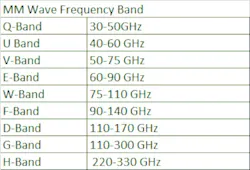
Even though mmWave introduces much larger bandwidths, realizing radio transceivers across the entire bandwidth is a nearly impossible task. Especially if one wants to maintain sine qua non. So there’s much yet to be conquered.
And the real 6G discussion is around the THz spectrum, where we’re barely scraping the surface. It will be the ultimate enabler for the ubiquitous communications network of tomorrow.
But going forward, 6G will have new and advanced iterations of RF technology and platforms — enough to claim that 6G is truly a generational increment. Why? The main reason is that 6G will not be a centralized network, as was the case with previous Gs. That has significant implications and breaks from all previous generations.
What Will be New and Significantly Evolved?
Innovations such as reconfigurable intelligent surfaces (RIS), which are arguably the most exciting technology of 6G, coupled with novel extreme coding and transmission schemes: polar, turbo, fountain, spatial, multidimensional index modulation, GLDPC, MDM, OTFS, advanced XXMA, and various combinations of these and others (phew). In addition, the introduction of new antenna configurations and the concept of every device serving as an access point will significantly transform the physical network infrastructure.
The foundational network facilitating device-to-device communications will be entirely decentralized. Furthermore, achieving the full potential of 6G will necessitate that a significant portion operates within the mmWave bands and at low power levels. This extends beyond just 10 GHz. Millimeter wave, and eventually THz, will serve as the primary spectrum for short-range communications.
Of course, current cellular-based communications will continue to exist, but they will assume a more high-level management role.
Two key propositions will shape 6G. The first involves the network (where everything will serve as an access point). The second pertains to the use of new reflective surfaces (primarily RIS). We currently possess conductive paints and films. Likewise, various other surface types and coatings are being explored as radiating mediums. The objective is to achieve widespread deployment of RIS across all surface types, both flexible and rigid.
The frequencies aren’t a significant concern, as the underlying physics of RF will remain unchanged. However, there will be important modifications in the frequency bands, along with the associated technologies and coding schemes. The vast number of devices becoming RF-enabled will require frequencies to accommodate a much higher volume of traffic than what current systems can support.
Drilling Down on Tech
Not long ago, I was introduced to a company, Cohere, which created an innovative coding scheme known as orthogonal time frequency and space (OTFS). This was cutting-edge at the time, but its moment has arrived today. The company continues to amaze me with its technological advances.
Others are developing various new and advanced iterations of shift-keying, multiple access, and multi-dimensional coding as well. And many more Coheres are coming onto the radar screen with coding schemes still in the labs or just being investigated.
Furthermore, let’s not forget that AI and software are the new golden children. 6G will be powered by them. There’s still some distance to cover before the telecommunications sector can fully incorporate and optimize these platforms. However, advanced versions of this will no doubt serve as the guiding principle for 6G.
Ahh, the RAN
The radio access network (RAN) must catch up. Open RAN (O-RAN) and virtual RANs (VRANs) have surprised most with their “failure to launch.” The high expectations that these technologies would rapidly infuse the transmission infrastructure and accelerate the proliferation of 5G was overestimated. Moreover, the resistance to it was underestimated.
However, it will thrive once the industry realizes that proprietary RAN is outdated in nearly all situations. As soon as AI and software reach the necessary level for scaling and deployment, it will become widespread. This is merely a preview of what lies ahead. But this also has several speed bumps to overcome.
6G Marches Forward, But the Wait Continues
Today, as I noted, 6G is still in the labs. Some like to point to platforms such as non-terrestrial networks (NTNs), uncrewed aircraft systems (UAS), high-altitude platforms (HAPs), various satellite platforms, and adding light to the network as harbingers of 6G. But glimpses of these will play out in 5G long before 6G is ubiquitous.
I sincerely hope we don’t witness another trumpet-blaring parade heralding 6G at any time by speculating on its potential. Instead, it should be what the approach to 5G should have been. We should build the technology and foundational platform and make them operational first. Following that, we should focus on developing practical use cases for it, rather than merely proselytizing its technology.
The search for 6G goes on. A quiet environment doesn’t mean a quiet segment. 6G is alive and well, and it’s good that we’re keeping a cooler head around it. The time will come when 6G will be all it can be, but it will be a few years before we get there.
About the Author
 Ernest Worthman
Ernest Worthman
Principal, Worthman & Associates
Ernest Worthman is the principal of Worthman & Associates, a high-tech industry analyst and an editorial columnist for a number of media outlets such as Endeavor Business Media’s Electronic Design and Informa’s 6G World. He is a nationally and internationally published technical editor/writer for wireless, semiconductor, cybersecurity, and other industries, and regularly speaks at industry events. He is a guest lecturer at Colorado State University’s College of Electrical Engineering.
Ernest’s present credentials include a B.S. Electronic Engineering Technology, A.A.S, Electronic Digital Technology; Senior and Life Member of the IEEE, a member of IEEE’s ComSoc, VTS, MTT, and 5G community, board member of the 6G Alliance, and a Panelist and session chair at various technical conferences.
Ernest has over 25 years of experience in high-tech print and online publishing. He’s held several editorial positions across a number of high-tech publications including Semiconductor Engineering’s cybersecurity and Internet of Everything/Everyone (IoX) channels, Editor of RF Design, and Editorial Director of Reed’s Wireless group, which included Wireless Design and Development and Fiber Optic Technology. He’s also been a contributing editor to Mobile Radio Technology, Satellite Communications, and others, as well as computer-related periodicals such as Windows NT.
His clients include Agilent (now Keysight) Technologies, RF Industries, GlobalFoundries, Advanced Linear Devices, Huawei, and others, for which he does technical and engineering writing and presents technical seminars.
Related
 Leaders Logo
Leaders relevant to this article: