Small Satellites Fly with X-Band Dynamic Modulation
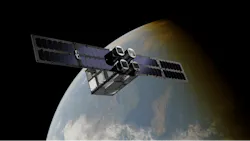
Small-satellite manufacturer U-Space selected Skynopy as a ground-station service provider for its SOAP and PANDORE low-Earth-orbit (LEO) satellites. The two companies are collaborating under the European Space Agency (ESA) Program for Userbase enhancement (PUSH) project to provide variable coding and modulation (VCM) at X-band frequencies in the small satellites.
The Satellite Optique pour Analyse et Positionnement des débris (SOAP) and PANDORE vehicles are the first two satellites entirely designed, assembled, and operated by U-Space from its Toulouse, France facilities. Both satellites fly at an altitude of 590 km in sun-synchronous orbit (see image above). SOAP is dedicated to surveillance from space, while PANDORE is flying an in-orbit demonstration (IOD) mission carrying Safran Space's Synchrocube payload to validate LEO-based positioning and synchronization.
Regarding the selection of Skynopy, Antoine Ressouche, co-founder and general manager of U-Space, explained, “Skynopy became the obvious choice once we seriously compared what was available on the market. The depth of their interface, the quality of real-time metrics, and above all, the ability to adapt the modulation rate during a pass fundamentally change how you operate a satellite in LEO.
Ressouche added that, "with X-band and VCM on the horizon, we are positioning our future satellites to deliver download performance our customers simply would not expect from a small satellite.”
In terms of the business arrangement, Antonin Hirsch, co-founder and CEO of Skynopy, explains, “Being trusted with two satellites simultaneously from an operator that has grown its own ground segment expertise in-house is a strong endorsement. U-Space is exactly the type of customer Skynopy was built for: ambitious, technically demanding operators who need a connectivity service that scales with them.”
Hirsch adds, “Our collaboration on the ESA PUSH program takes this further — proving that X-band VCM is accessible to nanosatellites is a major technological step forward for the entire small satellite industry.”
Learn more about small satellites and LEOs
 Satellite Dreamstime L 132219382

About the Author
Jack Browne
Technical Contributor
Jack Browne, Technical Contributor, has worked in technical publishing for over 30 years. He managed the content and production of three technical journals while at the American Institute of Physics, including Medical Physics and the Journal of Vacuum Science & Technology. He has been a Publisher and Editor for Penton Media, started the firm’s Wireless Symposium & Exhibition trade show in 1993, and currently serves as Technical Contributor for that company's Microwaves & RF magazine. Browne, who holds a BS in Mathematics from City College of New York and BA degrees in English and Philosophy from Fordham University, is a member of the IEEE.