Redefining Access Control for the Smart Home
What you'll learn:
- Why edge computing matters in applications like the smart home.
- How integration empowers innovation.
- Enabling security and interoperability.
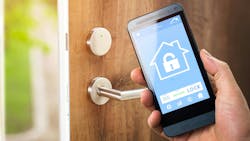
Access control has entered a new era. Intelligent controllers are moving decision-making from centralized servers to the edge of the network, bringing it right to the door. The result is faster performance, greater resilience, and new opportunities for customization that make access control more dynamic and adaptable than ever before.
Why Edge Matters
Edge computing has already transformed fields such as industrial automation and automotive design. By processing data closer to its source, engineers reduce latency, improve reliability, and enable real-time decision-making even when connectivity is unreliable. Physical access control is following the same path.
Traditionally, controllers enforced access rules locally, but their logic was limited to stored credentials and schedules. That’s changing thanks to the newest generation of controllers. With modern processors and embedded software environments, these devices can execute sophisticated logic, analyze data, and interact directly with other building and IT systems without waiting on a head-end server.
A Smarter Platform at the Door
Think of the modern access controller as a miniature application platform. Using standard SDKs and APIs, developers can deploy lightweight apps directly on the controller to perform specialized tasks. These could include:
- Monitoring network or device health in real-time
- Verifying configuration and certificate status
- Interfacing with building management or IoT systems
- Communicating with new types of access control hardware
- Running analytics on access patterns or door activity
By processing this information locally, systems respond instantly and continue operating smoothly even if network connectivity drops. This distributed approach also simplifies scaling because each controller becomes an autonomous node capable of managing its environment.
From Integration to Innovation
Edge-capable controllers don’t just replicate server logic at the door. They enable entirely new functionality. For example, developers can build apps that adjust access rules based on occupancy data, trigger energy-saving modes after hours, or alert maintenance teams when a device exhibits abnormal behavior.
This flexibility transforms access control from a static system into an adaptive infrastructure component that can evolve in the smart home, much like industrial IoT has done for manufacturing. Instead of closed systems with proprietary logic that limit innovation, access control is shifting toward open architecture and standards-based platforms. Openness encourages collaboration, faster development, and long-term interoperability across technologies and vendors.
Secure and Interoperable by Design
As intelligence moves outward, trust must move with it. Modern controllers incorporate secure boot, encrypted communications, and signed firmware to protect local decision-making. They also encrypt all data at rest, ensuring that credentials, logs, and configuration files remain protected even if the device is physically accessed or removed from the network.
Standardized interfaces such as Open Supervised Device Protocol (OSDP) Secure Channel and TLS ensure that readers, controllers, and host systems communicate securely while remaining interoperable across vendors.
The emphasis on open architecture and shared APIs allows organizations to integrate edge controllers seamlessly into hybrid or cloud environments. This approach maintains central oversight while empowering distributed intelligence.
Resilience at Scale
Because each controller stores policies, credentials, and event data locally, it continues enforcing rules and logging events even during a network outage. When connectivity is restored, the controller automatically synchronizes updates and uploads its event history, preserving audit integrity. This architecture eliminates single points of failure and brings true operational resilience to large or remote sites.
The Road Ahead
Edge computing will continue to blur the line between physical access and IT infrastructure. As controllers gain more processing power and functionality through APIs, they will take on tasks such as local risk scoring, behavior analytics, or coordination with enterprise cybersecurity systems.
For integrators and end users, this shift represents more than faster performance. It’s an entirely new development model. Instead of closed firmware updates, organizations can deploy purpose-built apps that evolve with business needs. Access control becomes an extensible platform that’s intelligent, secure, and open for innovation at the edge.
As access control becomes part of a unified digital ecosystem, its role within enterprise security expands. Controllers operating at the edge can participate directly in threat detection, data governance, and identity assurance — functions once reserved for centralized IT. This alignment transforms access control from a standalone physical safeguard into a critical layer of enterprise defense, one that strengthens resilience across both the physical and digital domains.
About the Author
 Jeremy Fromm
Jeremy Fromm
Evangelist, Mercury Security
Jeremy Fromm is an Evangelist at Mercury Security. Prior to his current role, he was the Sales Director of Shooter Detection Systems. Jeremy completed his education at Roberts Wesleyan University.