Skynopy, Look Up Team on Satellite Collision Avoidance
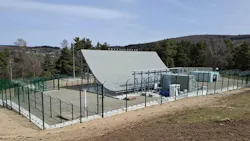
By selecting Skynopy for its satellite ground-station expertise, French surveillance company Look Up has taken a strong step toward establishing end-to-end collision-avoidance services for low-Earth-orbit (LEO) satellites. Look Up tapped Skynopy to provide the ground segment interface for its Acceleration Towards LEO Automated Space Safety (ATLAS) project (see image above).
As part of the contract, Skynopy will develop and integrate its virtualized ground station network with the ATLAS automated space-safety platform. The network will enable real-time command and control of the satellites in response to collision threats detected by Look Up’s proprietary radar network. Over 15,000 active satellites currently compete with hundreds and thousands of debris fragments in LEO and the risk of catastrophic collisions is increasing rapidly.
The ATLAS project, which is co-funded by the European Innovation Council (EIC) Accelerator Challenge, makes use of Look Up’s global network of seven radars across European Union (EU) territories. The radar systems can detect debris as small as a few centimeters in length. ATLAS combines with SYNAPSE, Look Up's data-fusion and analysis system for threat detection and maneuvering of satellites.
As Antonin Hirsch, CTO and co-founder of Skynopy, explains, “This collaboration with Look Up is a first of its kind. For the first time, a collision-avoidance detection system will be directly and automatically connected to a ground station network capable of commanding a real satellite. This is a critical building block for the future of sustainable space operations.”
Michel Friedling, CEO and co-founder of Look Up, added, “With ATLAS, we aim to connect detection directly to action in orbit. Skynopy stood out for its speed of execution, technical depth, and ability to interface with complex systems, making its ground segment a key enabler in transforming our detection capabilities into an operational collision-avoidance service.”
Learn more about the dangers of orbiting debris
 spacejunk_dreamstime_l_280087088
 desept112_promo
About the Author
Jack Browne
Technical Contributor
Jack Browne, Technical Contributor, has worked in technical publishing for over 30 years. He managed the content and production of three technical journals while at the American Institute of Physics, including Medical Physics and the Journal of Vacuum Science & Technology. He has been a Publisher and Editor for Penton Media, started the firm’s Wireless Symposium & Exhibition trade show in 1993, and currently serves as Technical Contributor for that company's Microwaves & RF magazine. Browne, who holds a BS in Mathematics from City College of New York and BA degrees in English and Philosophy from Fordham University, is a member of the IEEE.