Army’s Tropic Lightning Division Tests Command and Control in the Field
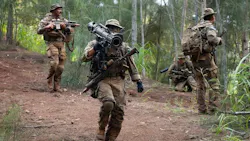
Preparing new technologies for the battlefield requires operational use and testing under working conditions, and the U.S. Army’s Tropic Lightning division evaluates command-and-control architectures for the field. To ready the most advanced equipment for use, soldiers must find it straightforward in operation, especially in a wirelessly connected operating environment. It must provide continuous operation under the most hostile operating conditions. For Army Major Nathan Sitterley and soldiers assigned to the 2nd Mobile Brigade, 25th Infantry Division, analysis, and testing of advanced equipment ready it for a live, tactical fight.
Sitterly offers the need for controlled testing upfront: “The controlled environment gets you to the 50-yard line.” He adds the importance of in-field testing: “The last 50 yards happen out here, where you're battling latency, power, and connectivity issues right alongside the opposition force. This is where we forge a real combat capability.” The Tropic Lightning division helps improve equipment decision speed and operational effectiveness for equipment used in the Pacific region under tough operating conditions (see figure). What works well in the laboratory must be validated “in the dirt,” under actual operating conditions, during a phase which brigade leaders refer to as the “last tactical mile” of technology integration.
The division’s lead data engineer, Army Major Rebecca Borrebach, noted: “The goal is to get the right data to the right leader at the right time.” She added: “We're validating our ability to push a common operating picture from the cloud to the tactical edge, even in a disconnected environment. It's about giving the tactical units the situational awareness they need to make faster, better-informed decisions.” Army Major Jay Trexler, the division's innovation officer, concluded: “The feedback from the field is clear: if a soldier can't figure it out quickly under pressure, it's not a combat-effective tool.” The goal of building a combat-ready force in the Pacific region does not require a single system or technology but the steady evolution of people, processes, and systems.
About the Author
Jack Browne
Technical Contributor
Jack Browne, Technical Contributor, has worked in technical publishing for over 30 years. He managed the content and production of three technical journals while at the American Institute of Physics, including Medical Physics and the Journal of Vacuum Science & Technology. He has been a Publisher and Editor for Penton Media, started the firm’s Wireless Symposium & Exhibition trade show in 1993, and currently serves as Technical Contributor for that company's Microwaves & RF magazine. Browne, who holds a BS in Mathematics from City College of New York and BA degrees in English and Philosophy from Fordham University, is a member of the IEEE.
Related
 Leaders Logo
Leaders relevant to this article: