Team Testing Vets Osprey Sonobuoys
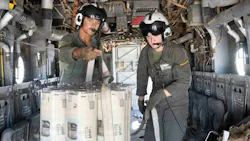
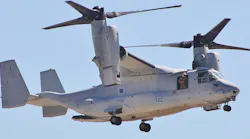
Acceptance testing of by a joint measurement crew off the coast of San Clemente Island, Calif., on August 19, 2026 has verified the quality of the first lot of sonobuoys from an MV-22B Osprey tiltrotor aircraft. Testing was performed by a team from the Air Anti-Submarine Warfare Systems Program Office, the Osprey Joint Program Office, and Marine Operational Test and Evaluation Squadron 1.
With overwater testing, the sonobuoys were found to perform reliably and serve as potential systems for expanded use across the fleet (see image above).
According to U.S. Navy Captain Greg Hinkle, program manager of the Air Anti-Submarine Warfare Systems Program Office, “Our primary focus in the quality assurance program is making sure the sonobuoys delivered to the fleet perform exactly as expected.”
The Navy has relied on P-3C Orion aircraft assigned to the Air Test and Evaluation Squadron 30 to perform quality assurance drops using automated launchers. Hinckle noted, “By utilizing the [Osprey] for this type of mission, we are reinforcing our supply chain and ensuring front line aircrews have the mission-ready stores they need to detect and track undersea threats.”
Modified test methods were required for the Osprey compared to the Orion aircraft. While the Orion launches via automated launch containers triggered from the cockpit, the Osprey are hand-launched by aircrew from an open rear cargo ramp. The differences in deployment require evaluation members to adjust flight speeds to match precise target patterns and spacings required for accurate acoustical testing of the Osprey sonobuoys.
Regarding the team testing effort, Marine Corps Lieutenant Colonel Brandon Pope, Osprey pilot and advanced projects lead assigned to the Marine Operational Test and Evaluation Squadron 1, said, “From an aircrew standpoint, this event provided an invaluable opportunity for our pilots and crew chiefs to build proficiency working through the mechanics of manual sonobuoy drops in a controlled setting.”
Learn more about defense technologies

About the Author
Jack Browne
Technical Contributor
Jack Browne, Technical Contributor, has worked in technical publishing for over 30 years. He managed the content and production of three technical journals while at the American Institute of Physics, including Medical Physics and the Journal of Vacuum Science & Technology. He has been a Publisher and Editor for Penton Media, started the firm’s Wireless Symposium & Exhibition trade show in 1993, and currently serves as Technical Contributor for that company's Microwaves & RF magazine. Browne, who holds a BS in Mathematics from City College of New York and BA degrees in English and Philosophy from Fordham University, is a member of the IEEE.