Curved Radio Waves Considered for Surreptitious Wireless Jamming
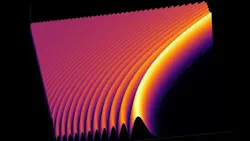
Curved radio beams are being studied for a new form of wireless jamming with a difficult-to-trace interference source. Research performed at Rice University (Houston, Texas) and supported by the National Science Foundation (NSF) was recently presented at the 47th IEEE Symposium on Security and Privacy.
Unlike conventional RF/microwave jammers, these interference sources can't be easily identified and traced to a source, making them difficult for an enemy to interrupt or defeat.
As Edward Knightly, Sheafor-Lindsey Professor and professor of electrical and computer engineering and computer science at Rice, admitted, “This is the first demonstration of a jammer that cannot be reliably localized, and the first time self-curving wireless beams have been used as an attack.”
He added, “Our work uncovers a new kind of threat: A wireless device can be tricked into ‘seeing’ an attacker in the wrong place, making it harder to avoid interference or stop the source.”
Jammers disrupt the use of wireless signals in communications and Global Positioning System (GPS) equipment by adding excessive interference to the operating environment. The interference can totally disable GPS tracking and render worthless newer weapons systems, such as those on drones.
By estimating the direction of arrival (DOA) for radio waves, a jammer’s source can be located and destroyed. But with curved radio waves (see image above), the target location may not be so simple or routine.
According to Caroline Spindel, a doctoral student in the Knightly lab who co-authored the research, “We show how a jammer can shape wireless wavefronts to curve a beam, making the attack appear to come from a false location.” The researchers used mathematical modeling, simulations, and experiments to show that an attacker could manipulate these radio beams to cause misidentification of jamming source locations.
Learn more about jamming/anti-jamming technologies
 A GPS satellite orbiting the Earth.
 Military Computer Promo

About the Author
Jack Browne
Technical Contributor
Jack Browne, Technical Contributor, has worked in technical publishing for over 30 years. He managed the content and production of three technical journals while at the American Institute of Physics, including Medical Physics and the Journal of Vacuum Science & Technology. He has been a Publisher and Editor for Penton Media, started the firm’s Wireless Symposium & Exhibition trade show in 1993, and currently serves as Technical Contributor for that company's Microwaves & RF magazine. Browne, who holds a BS in Mathematics from City College of New York and BA degrees in English and Philosophy from Fordham University, is a member of the IEEE.