New Tech Tuesdays: Ensuring Healthy Indoor Environments with Multimodal Air Sensing
Key Highlights
- Integrated multi-parameter sensors consolidate environmental measurements, reducing component count and simplifying system design.
- Advancements in sensing technology enable real-time, comprehensive indoor air quality monitoring, supporting healthier and more comfortable environments.
- Edge intelligence allows sensors to perform local data analysis, decreasing latency and network traffic while enabling faster decision-making.
- Modern IAQ systems can dynamically adjust ventilation and air purification based on occupancy, particulate levels, and humidity, optimizing energy use.
- Design considerations include enclosure geometry, contamination resistance, and long-term measurement stability to ensure sensor reliability.
On September 1, 2026 in All, Industrial, IoT, Sensors by Mouser Technical Content Staff
Join Mouser's Technical Content team for a weekly look at all things interesting, new, and noteworthy for design engineers.
Indoor air quality (IAQ) is an important measure of indoor environmental conditions that can affect comfort, productivity, and health. Commercial building standards such as ANSI/ASHRAE Standard 62.1 specify minimum ventilation rates and other measures intended to support acceptable indoor air quality, but building managers also need sensor networks to monitor whether indoor conditions and ventilation strategies are performing as expected.[1]
Multi-parameter sensors that simultaneously monitor particulate matter, temperature, and humidity help make ventilation systems more effective. Much like Internet of Things (IoT) monitoring systems that rely on multiple environmental inputs to improve visibility and decision-making, modern IAQ platforms measure a variety of parameters with multiple sensor types.
This week's New Tech Tuesdays explores why indoor air quality sensing is becoming central to smart building design, the shift from distributed to integrated sensing technology, how edge intelligence optimizes environmental data, and what engineers should consider when streamlining next-generation architectures.
Shifting from Distributed to Integrated IAQ Sensors
Environmental monitoring traditionally relies on separate sensing elements distributed throughout a building. Temperature, humidity, and particulate sensors frequently require independent design efforts, calibration strategies, and software integration. While effective, this approach increases overall system complexity.
Several market shifts have accelerated the move toward integrated air-quality sensing. Demand for intelligent heating, ventilation, and air conditioning (HVAC) systems has grown. These systems are capable of adjusting airflow based on environmental conditions rather than fixed schedules.[2] Additionally, growing awareness of indoor environmental quality has increased interest in real-time monitoring of airborne particulates and carbon dioxide.[3]
Advances in sensing technology have also enabled multiple environmental measurements to be integrated into a single device. Similar trends have appeared across industrial and IoT applications, where integrated sensing platforms provide more complete operational visibility while simplifying system architecture. Environmental data streams that once required several sensing nodes can now be gathered from a single location and processed as part of a unified monitoring strategy.
For engineers, integration offers advantages beyond reducing component count. A multi-parameter sensor integrates sensor placement, airflow management, interface design, and calibration into a single device.
Leveraging Edge Intelligence and Environmental Data
The future of indoor air quality sensing extends beyond simple measurement. Environmental data are increasingly combined with automation platforms, occupancy information, and energy management systems to optimize building performance in real time.
As sensing networks become more widespread, building systems will become more sophisticated. Ventilation systems may adjust airflow dynamically based on particulate levels, occupancy density, and humidity conditions. Air purification equipment can operate only when needed, reducing energy consumption while maintaining desired air quality thresholds.
Edge intelligence is also beginning to influence environmental monitoring. Just as intelligent sensors and localized processing are enabling more responsive IoT devices, future building sensors may perform more analysis directly within the sensing platform itself. This approach can reduce latency, lower network traffic, and provide faster responses to changing environmental conditions.
Designers must still address enclosure geometry, airflow paths, contamination resistance, and long-term measurement stability. As reliance on environmental data in buildings increases, sensor accuracy and reliability will become even more critical. Success will depend on a balance of performance, integration simplicity, power consumption, and cost.
The Newest Products for Your Newest Designs®
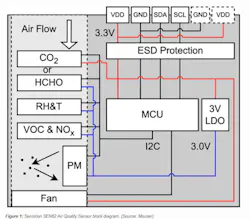
Designed for indoor air quality monitoring applications, the Sensirion SEN62 Air Quality Sensor combines multiple environmental sensing functions into a single integrated module (Figure 1). The module supports measurements of particulate matter, temperature, and humidity, enabling designers to gather a more complete picture of indoor environmental conditions from a single sensing node.
Figure 1: Sensirion SEN62 Air Quality Sensor block diagram. (Source: Mouser)
For engineers developing smart thermostats, HVAC controls, air purifiers, room monitors, and connected building systems, this integration can help reduce the need for multiple discrete sensors and associated design effort. Fewer sensing elements can simplify board-level integration, firmware development, and enclosure design while still providing the environmental information required for modern IAQ applications.
By consolidating multiple measurements into a single platform, the SEN62 module helps designers create products that deliver richer environmental insights while reducing overall sensing complexity.
Tuesday’s Takeaway
As smart buildings become more prevalent and expectations for healthy indoor environments continue to rise, multi-parameter sensing is becoming a foundational design element rather than an optional feature. With systems that can measure particulate matter, temperature, and humidity, occupants can better understand their environment. These systems also allow engineers to simplify product architectures. The results are better data, smarter decisions, and healthier indoor spaces.
This blog was generated with assistance from Copilot for Microsoft 365.
Sources
[1] https://blog.ansi.org/ansi/ansi-ashrae-62-1-2025-ventilation-indoor-air/
[2] https://www.buildings.com/building-systems-om/hvac/article/55136152/is-your-current-hvac-system-holding-back-energy-efficiency-make-it-smarter
[3] https://www.weforum.org/stories/2025/06/why-indoor-air-quality-must-be-a-global-health-priority/