UC Berkeley Assists Keysight on Faster FR3 Wireless Testing
As wireless applications employ higher frequencies for available bandwidth, demand increases for test solutions capable of characterizing higher-frequency components and systems. By working with the Berkeley Wireless Research Center (BWRC), Keysight Technologies is designing and developing measurement solutions for wireless testing in frequency range 3 (FR3) from 7.125 to 24.250 GHz. The firm offers test equipment for components and systems in FR1 below 6 GHz and at much higher frequencies in FR2 from 24.25 to 71.00 GHz. The middle-frequency range is expected to require use with expansion of Fifth Generation (5G) and Sixth Generation (6G) terrestrial and nonterrestrial-network (NTN) applications.
Assistant Professor Aditya Muppala at the University of California, Berkeley (UC Berkeley) is heading research to explore faster, more accurate methods of wireless testing. He exclaimed: “I’m excited to have Keysight behind this research as we explore new approaches to over-the-air antenna measurement. We believe these techniques have the potential to be a game changer for how OTA systems are deployed in real-world environments, making advanced measurements faster, more flexible, and more practical for emerging wireless systems.”
Giampaolo Tardioli, Vice President and General Manager at Keysight, said: “Keysight is excited to work with BWRC to advance innovative approaches to wireless testing. By bringing together BWRC’s pioneering research with Keysight’s test expertise and real-world OTA chamber capabilities, we believe this work can lead to important breakthroughs and help accelerate industry adoption of faster, more flexible measurement techniques for 6G.”
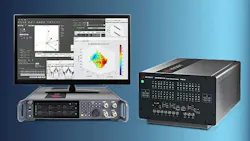
Test equipment for 5G/6G wireless FR3 system and component testing can emulate the amplitude, frequency, and phase of multiple-channel wireless networks. An FR3 system tester from Keysight Technologies (see figure), for example, provides the hardware and multiple-channel software needed to coordinate measurements quickly and accurately. The equipment includes artificial intelligence (AI) enhancements to enable additional functions, such as integrated sensing and communications (ISAC) for detecting and tracking objects.
Learn more about 5G test and measurement


About the Author
Jack Browne
Technical Contributor
Jack Browne, Technical Contributor, has worked in technical publishing for over 30 years. He managed the content and production of three technical journals while at the American Institute of Physics, including Medical Physics and the Journal of Vacuum Science & Technology. He has been a Publisher and Editor for Penton Media, started the firm’s Wireless Symposium & Exhibition trade show in 1993, and currently serves as Technical Contributor for that company's Microwaves & RF magazine. Browne, who holds a BS in Mathematics from City College of New York and BA degrees in English and Philosophy from Fordham University, is a member of the IEEE.