Test Platform Offers Expanded Multichannel Synchronization
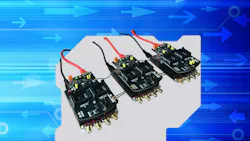
Red Pitaya recently expanded its multichannel synchronization and high-speed streaming capabilities across its STEMlab 125-14 Gen 2 platform. Developers can now combine multiple STEMlab boards into synchronized, configurable setups, extending input and output capacity while maintaining precise clock and trigger alignment.
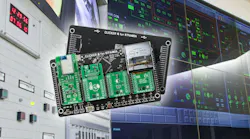
With Red Pitaya Click Shields and shared clock distribution, users can synchronize combinations of STEMlab 125-14 PRO Gen 2, STEMlab 125-14 PRO Z7020 Gen 2, STEMlab 125-14 4-Input, and SDRlab 122-16 boards into a single, coherent measurement system.
For example, pairing a STEMlab 125-14 PRO Gen 2 with a STEMlab 125-14 4-Input creates a synchronized six-input, two-output system; larger configurations can be assembled to suit specific application requirements. The clock-select architecture allows users to switch between the internal 125-MHz oscillator and an externally supplied reference clock, broadening synchronization possibilities.
The Click Shield architecture handles clock and trigger distribution via the ZL40213 LVDS clock fanout buffer, delivering deterministic alignment with sharp edge control across all boards.
Red Pitaya also enhanced the streaming architecture of its Gen 2 boards, and with software optimization, streaming throughput between board and host computer has increased from 20 to 62.5 MB/s per board.
The updated Deep Memory Mode now supports both acquisition and generation, capturing incoming signals directly into memory or playing back data to the outputs at full core clock speed. It handles both short, high-speed bursts and longer continuous streams at up to 62.5 MB/s across synchronized multiboard setups from standard modular components.
Related links:
More New Products

About the Author
 Alix Paultre
Alix Paultre
Editor-at-Large, Microwaves & RF
Alix is Editor-at-Large for Microwaves & RF.
An Army veteran, Alix Paultre was a signals intelligence soldier on the East/West German border in the early ‘80s, and eventually wound up helping launch and run a publication on consumer electronics for the U.S. military stationed in Europe. Alix first began in this industry in 1998 at Electronic Products magazine, and since then has worked for a variety of publications, most recently as Editor-in-Chief of Power Systems Design.
Alix currently lives in Wiesbaden, Germany.