Transceiver Tackles 2.4-GHz ISM Band Using DSSS Modulation
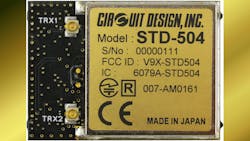
Distributor Saelig Company Inc. recently introduced the STD-504 ISM-band wireless communications transceiver module, manufactured by Japanese firm Circuit Design Inc. Compliant with EN, FCC, ISED, and ARIB standards to serve global applications, the compact transceiver (see image above) operates on low voltage with high efficiency in battery-powered systems.
Equipped with a +3.3-V DC power supply, the device typically consumes 55-mA current during transmissions and 60 mA during reception. Capable of withstanding interference in the crowded 2.4-GHz wireless band, it provides line-of-sight (LOS) communications at distances to 300 m and beyond.
Using direct-sequence spread-spectrum (DSSS) modulation technology, the transceiver incorporates two independent receiving circuits to capture the highest-level signals in the 2.4-GHz band. By selecting from multiple antennas, the transceiver can similarly optimize signal strength during transmissions.
The transceiver supports 75 RF channels and features an on-board temperature sensor for stable operation at data rates to 19.2 kb/s over wide operating temperature ranges.
Circuit Design supplies a range of low-power radio modules for industrial applications, including for monitoring, remote control, and telemetry purposes.
Learn more about transceiver modules
 dreamstime_m_128317197
About the Author
Jack Browne
Technical Contributor
Jack Browne, Technical Contributor, has worked in technical publishing for over 30 years. He managed the content and production of three technical journals while at the American Institute of Physics, including Medical Physics and the Journal of Vacuum Science & Technology. He has been a Publisher and Editor for Penton Media, started the firm’s Wireless Symposium & Exhibition trade show in 1993, and currently serves as Technical Contributor for that company's Microwaves & RF magazine. Browne, who holds a BS in Mathematics from City College of New York and BA degrees in English and Philosophy from Fordham University, is a member of the IEEE.