InGaAs Infrared Sensors Target Hunting, Long-Range Shooting Apps
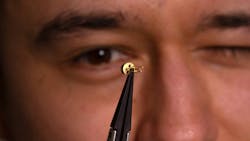
Used in demanding defense, telecom, and industrial applications, Phlux Technology's Noiseless InGaAs infrared sensors can also supplement advanced hunting and professional shooting optics. Able to detect faint infrared signals in the 1550-nm range, indium-gallium-arsenide (InGaAs) avalanche photodiode (APD) technology delivers an order of magnitude higher sensitivity than legacy near‑infrared detectors.
First adopted in laser range finders in the defense industry and optical test equipment for fiber‑network monitoring, the sensors will operate in laser rangefinders, integrated ballistic scopes, and specialist low‑light targeting systems, too. Specialty versions have been developed to address these applications, as hunting and shooting optics have come to rely on laser range finding and digital fire‑control.
By operating at around 1550 nm, an eye‑safe infrared wavelength, system designers can legally and safely use higher laser powers than when using traditional 905-nm solutions. The combination of ultra‑low noise and high internal gain enables the detection of weaker return pulses, for an extended effective ranging distance, smaller-sized optics, and reduced power consumption.
Related links:
More New Products
 dreamstime_verticalarray_29944431promo
About the Author
 Alix Paultre
Alix Paultre
Editor-at-Large, Microwaves & RF
Alix is Editor-at-Large for Microwaves & RF.
An Army veteran, Alix Paultre was a signals intelligence soldier on the East/West German border in the early ‘80s, and eventually wound up helping launch and run a publication on consumer electronics for the U.S. military stationed in Europe. Alix first began in this industry in 1998 at Electronic Products magazine, and since then has worked for a variety of publications, most recently as Editor-in-Chief of Power Systems Design.
Alix currently lives in Wiesbaden, Germany.