High-Isolation RF Switches Serve Infrastructure, Test Apps
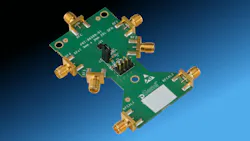
Offering low insertion loss as well as high isolation and linearity, pSemi's PE42544 SP4T and PE42429 SPDT RF switches target next-generation wireless infrastructure, test and measurement, and automated test equipment applications.
The PE42544 high-isolation UltraCMOS+ SP4T RF switch operates from 9 kHz to 8.5 GHz with up to 40-dB isolation, featuring an insertion loss of 1.4 dB at 8.5 GHz and a switching time of 300 ns. Leveraging pSemi’s UltraCMOS+ RF-SOI technology with HaRP enhancements, the 20-lead, 3- × 3-mm, QFN-packaged device provides a linearity of 61 dBm IIP3 with an operating temperature range from –40 to +105°C.
The PE42429 high-isolation UltraCMOS+ SPDT RF switch is designed for wireless infrastructure, test and measurement equipment, and ATE systems. Also operating from 9 kHz to 8.5 GHz, it has 46-dB isolation at 6 GHz, an insertion loss of 1.1 dB at 8.5 GHz, and a 490 ns switching time. It also implements HaRP technology and the UltraCMOS+ RF-SOI process for 65-dBm IIP3 linearity, and maintains performance from –40 to +105°C in a 12-lead, 2.0- × 2.0-mm QFN package.
In addition, the company released the high-isolation PE42727 UltraCMOS SPDT RF Switch for next‑generation broadband cable applications, DOCSIS 4.0, and future-generation broadband architectures. The HaRP‑enhanced SPDT RF switch for cable broadband applications, operating from 5 MHz to 3.1 GHz, offers high surge protection, notable linearity, and harmonic performance that includes a –121-dBc second harmonic and –140-dBc third harmonic at 17 MHz.
Related links:
More New Products

About the Author
 Alix Paultre
Alix Paultre
Editor-at-Large, Microwaves & RF
Alix is Editor-at-Large for Microwaves & RF.
An Army veteran, Alix Paultre was a signals intelligence soldier on the East/West German border in the early ‘80s, and eventually wound up helping launch and run a publication on consumer electronics for the U.S. military stationed in Europe. Alix first began in this industry in 1998 at Electronic Products magazine, and since then has worked for a variety of publications, most recently as Editor-in-Chief of Power Systems Design.
Alix currently lives in Wiesbaden, Germany.