UWB SoCs Support Latest IEEE Standards in Auto and Smart Device Apps
The Overview: SoCs Support IEEE 802.15.4ab UWB Standard
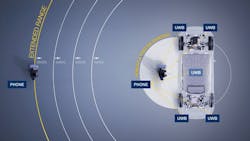
STMicroelectronics’ ST64UWB family of SoCs are an industry first with their support for the upcoming IEEE 802.15.4ab UWB standard as well as the IEEE 802.15.4z (FiRa) standard. They bring enhancements that extend operating range, boost processing power, and step up robustness in new automotive, consumer, and industrial use cases.
Who Needs It & Why: Realizing Next-Generation Key Fobs and Radar Sensing
The IEEE 802.15.4ab standard builds on the 802.15.4z standard, bringing a host of improvements that are expected to make ultrawideband technology applicable to a much broader range of use cases. Chips built on the new standard can perform more reliably in automotive key fobs and strengthen UWB connections from devices carried in bags or rear pockets.
We can expect to see 802.15.4ab devices incorporated into coming generations of vehicles and smartphones as well as hands-free door locks, among other smart-home-related end products.
Thanks to technical improvements in 802.15.4ab, such as multi-millisecond ranging (MMS) and narrowband assistance (NBA), the new SoCs enable direction finding at close range to better interpret user intent. IEEE 802.15.4ab also enhances radar mode, improving use cases such as child presence detection (CPD) in vehicles
Under the Hood: Versions for Automotive and Commercial/Consumer Use Cases
The three SoCs introduced today (ST64UWB-A100, ST64UWB-A500, and ST64UWB-C100) are built on an 18-nm FD-SOI process that boosts link budget by nearly 3 dB versus standard bulk technologies. They extend range by roughly 50% beyond the gains already delivered by the IEEE 802.15.4ab standard.
The ST64UWB-A series, designed for automotive applications and starting with the ST64UWB-A100 for use cases such as digital key and precise vehicle localization, features an Arm Cortex-M85 core and supports the ASIL A(B) automotive safety concept.
The ST64UWB-A500 adds AI acceleration and digital signal processing to support edge AI-powered radar applications, including child presence detection (CPD); kick sensing; and outward-facing use cases, such as parking sensors and radar-based vehicle-sentinel mode.
These radar capabilities benefit from the new 15.4ab Kaiser pulse shape and the upgraded 1.3-GHz bandwidth of UWB channel 11. The end result is twice the accuracy compared to 500-MHz channels.
The ST64UWB-C100, built on an Arm Cortex-M85 core, targets commercial and consumer applications, delivering best-in-class hands-free and tap-free user experiences with full Aliro standard compatibility.
To support application development, ST offers a comprehensive development kit that includes a UWB stack (PHY/MAC), radar toolbox, development boards, reference design for antennas, and application examples for both automotive and consumer markets.
About the Author
 David Maliniak
David Maliniak
Executive Editor, Microwaves & RF
I am Executive Editor of Microwaves & RF, an all-digital publication that broadly covers all aspects of wireless communications. More particularly, we're keeping a close eye on technologies in the consumer-oriented 5G, 6G, IoT, M2M, and V2X markets, in which much of the wireless market's growth will occur in this decade and beyond. I work with a great team of editors to provide engineers, developers, and technical managers with interesting and useful articles and videos on a regular basis. Check out our free newsletters to see the latest content.
You can send press releases for new products for possible coverage on the website. I am also interested in receiving contributed articles for publishing on our website. Use our contributor's packet, in which you'll find an article template and lots more useful information on how to properly prepare content for us, and send to me along with a signed release form.
About me:
In his long career in the B2B electronics-industry media, David Maliniak has held editorial roles as both generalist and specialist. As Components Editor and, later, as Editor in Chief of EE Product News, David gained breadth of experience in covering the industry at large. In serving as EDA/Test and Measurement Technology Editor at Electronic Design, he developed deep insight into those complex areas of technology. Most recently, David worked in technical marketing communications at Teledyne LeCroy, leaving to rejoin the EOEM B2B publishing world in January 2020. David earned a B.A. in journalism at New York University.