LoRa Transceivers Solve Range vs. Data Rate Tradeoff Conundrum
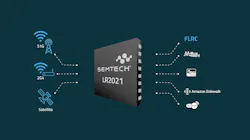
In augmenting its lineup of LoRa Plus transceivers, Semtech now addresses a full range of IoT application requirements from sub-GHz deployments to multiband global tracking with satellite connectivity.
The introduction of the LR2022 and LR2012 transceivers, which, like the earlier LR2021 device, are based on the company’s fourth-generation LoRa IP, offer backward compatibility with LoRaWAN; long-range, frequency-hopping spread spectrum (LR-FHSS); and legacy on-off-keying (OOK) devices.
The new transceivers deliver radio performance with best-in-class sensitivity featuring extended data rates up to 125 kb/s for LoRa and 2 Mb/s for frequency-shift-keying (FSK) applications. This throughput enables high-speed burst data transmissions within a low-power envelope to support large file transfers, including images, audio, and firmware-update-over-the-air (FUOTA) updates. The devices also support use cases requiring very low latency in proprietary wireless protocols.
Historically, wireless data communication runs up against a tradeoff between long transmission ranges and high data rates. The LR2021 is a multi-band, multi-protocol transceiver with a high-speed burst mode that Semtech calls Fast Long-Range Communications modulation. It supports data rates up to 2.6 Mb/s for edge-AI applications on both sub-GHz and 2.4-GHz ISM bands.
For its part, the LR2022 is a multi-band, single-hardware-design transceiver for global terrestrial and non-terrestrial networks (NTNs). It operates in the sub-GHz and 2.4-GHz ISM bands, too, as well as the licensed S-band. The older LR2012 is a sub-GHz-only transceiver optimized for traditional low-power wireless and LPWAN applications.
About the Author
 David Maliniak
David Maliniak
Executive Editor, Microwaves & RF
I am Executive Editor of Microwaves & RF, an all-digital publication that broadly covers all aspects of wireless communications. More particularly, we're keeping a close eye on technologies in the consumer-oriented 5G, 6G, IoT, M2M, and V2X markets, in which much of the wireless market's growth will occur in this decade and beyond. I work with a great team of editors to provide engineers, developers, and technical managers with interesting and useful articles and videos on a regular basis. Check out our free newsletters to see the latest content.
You can send press releases for new products for possible coverage on the website. I am also interested in receiving contributed articles for publishing on our website. Use our contributor's packet, in which you'll find an article template and lots more useful information on how to properly prepare content for us, and send to me along with a signed release form.
About me:
In his long career in the B2B electronics-industry media, David Maliniak has held editorial roles as both generalist and specialist. As Components Editor and, later, as Editor in Chief of EE Product News, David gained breadth of experience in covering the industry at large. In serving as EDA/Test and Measurement Technology Editor at Electronic Design, he developed deep insight into those complex areas of technology. Most recently, David worked in technical marketing communications at Teledyne LeCroy, leaving to rejoin the EOEM B2B publishing world in January 2020. David earned a B.A. in journalism at New York University.