Zigbee’s Next Phase: Security, Range, and Sub-GHz Expansion
What you’ll learn:
- Zigbee 3.0 remains highly popular as a mature LPWAN standard.
- New product development is increasingly focused on the latest Zigbee 4.0 release.
- The Suzi sub-GHz extension to Zigbee enables extended range for the protocol.

Low-power wireless networks remain foundational to connected devices across consumer, commercial, and industrial environments. The scale of deployments is expanding in areas such as smart buildings, large commercial installations, multi-dwelling units (MDUs), and industrial monitoring systems.
At the same time, expectations around security, device longevity, and interoperability are on the rise. Regulatory pressure around cybersecurity requirements for connected devices continues to escalate globally. Everything from smart lighting to critical infrastructure sensors demand more robust protection. These pressures are driving the next phase of development within established standards like Zigbee. Related extensions such as sub-GHz capabilities (Suzi) as well as the introduction of Zigbee 4.0 reflect this broader industry shift.
Zigbee 3.0 Remains Widely Deployed in Networking Use Cases
Before examining the evolution, it’s important to acknowledge the installed base. Zigbee 3.0 operates as a mature, widely deployed networking standard. Existing products and legacy deployments are still fully supported. Certification programs for Zigbee 3.0 remain active for legacy devices and recertification of existing products.
The ecosystem is expected to operate in a hybrid period where existing devices continue shipping on Zigbee 3.0 while new development increasingly targets Zigbee 4.0. This gradual transition of the large installed base allows the ecosystem to preserve compatibility and introduce new capabilities.
Why New Product Development is Moving Toward Zigbee 4.0
New product development increasingly focuses on Zigbee 4.0 implementations built on the latest stack releases (see figure). Updated certification programs such as Rapid Certification and Fast Track help accelerate adoption of newer stacks. For many developers, moving to the Zigbee Compliant Platform Revision 23 (R23 stack) effectively aligns with implementing Zigbee 4.0 features. The evolution reflects several technical priorities, including:
- Improved security architecture
- Expanded deployment flexibility
- Improved support for large and complex networks
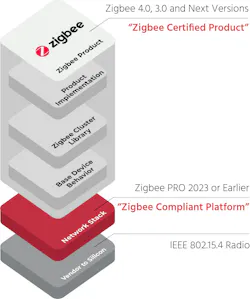
Security architecture is among the most important areas of evolution.
Security Turning into a Primary Design Driver
Connected devices increasingly fall under new regulatory frameworks for cybersecurity. Security continues to evolve as new threats emerge, making agility more critical as deployments grow in complexity, especially in commercial and infrastructure settings.
Zigbee 4.0 includes comprehensive and proactive security updates aligned with evolving international security standards by implementing cryptographic agility and additional mechanisms to protect the network.
It strengthens security through improvements at the APS layer. This leads to stronger protection for device-to-device communication, improved credential and key management, and greater resilience against device compromise. Such capabilities align with the growing expectations of regulators, infrastructure operators, and system integrators.
Beyond security improvements, the evolution of Zigbee expands the range and deployment flexibility of wireless networks.
Expanding Range and Deployment Options with Sub-GHz (Suzi)
One development associated with Zigbee 4.0 is the North American and EU sub-GHz extension known as Suzi. While Zigbee has historically operated primarily in the 2.4-GHz ISM band, sub-GHz support allows for deployments that require longer range, improved propagation through buildings, and large-scale infrastructure coverage.
Sub-GHz implementations have already been proven in markets such as the UK, where large energy infrastructure deployments have operated for more than a decade. Suzi enables new deployment scenarios in outdoor environments, large campuses, multi-dwelling units, and large commercial facilities. These capabilities are designed to work alongside existing Zigbee networks rather than replacing them.
Bridging 2.4-GHz and Sub-GHz Networks
Zigbee supports bridge devices that operate across both 2.4-GHz and sub-GHz interfaces. As a result, systems can maintain compatibility with existing Zigbee networks and extend range using sub-GHz radios where needed. While sub-GHz support is in place, Suzi can be enabled by manufacturers without major hardware redesign. This approach allows developers to extend network capabilities without disrupting installed infrastructure.
Alongside expanded radio capabilities, the ecosystem is also evolving toward multi-protocol device strategies.
Multi-Protocol Device Architectures
The connected device industry generally recognizes that no single wireless protocol addresses every deployment requirement. Many manufacturers now design multi-protocol devices capable of supporting multiple wireless standards simultaneously.
In this environment, Zigbee is often used alongside other Connectivity Standards Alliance protocols, such as Matter, to support different networking requirements. With this approach, device makers are able to develop future-proof products, adapt to evolving ecosystem requirements, and support multiple application environments.
Despite these changes, several fundamental design characteristics continue to make Zigbee well-suited for home automation, energy, and large-scale commercial deployments.
Design Characteristics that Continue to Support Zigbee Deployments
Zigbee offers a combination of low power consumption and efficient networking. Both are difficult to replicate in other wireless standards. Key advantages include:
- Ultra-low power requirements
- Small memory footprint
- Reliable mesh networking
- Support for both cloud-connected and fully local deployments
Zigbee can operate in environments where internet connectivity is intermittent, or data must remain local for privacy or regulatory reasons. These characteristics will help Zigbee continue to play an important role in residential, commercial, and infrastructure deployments.
Incremental Network Evolution
The transition toward Zigbee 4.0 is expected to be gradual rather than disruptive. Thus, existing Zigbee 3.0 deployments are expected to remain operational for years. New product development will increasingly adopt enhanced security features, sub-GHz capabilities, and multi-protocol device architectures. In the end, Zigbee will continue to evolve to address market demands and ensure its technology stays future-ready.
About the Author
 Genie Peshkova
Genie Peshkova
President, DSR Corp. and Chair, Zigbee Marketing & Product Subgroup, Connectivity Standards Alliance
Genie Peshkova is the President of DSR Corp., leading all operations and management of the company's project portfolio. She is involved in top-level strategy, business planning, business development and marketing, negotiation and execution of deals, as well as management of relationships with existing client accounts.
In addition, Peshkova serves as the Chair of the Zigbee Marketing & Product Subgroup Committee at the Connectivity Standards Alliance, also serving as a Board Member of the Zigbee Steering Committee. She holds a Bachelor's degree in Mathematical and Computer Sciences from Colorado School of Mines.