Selecting a Multi-Use Industrial Gateway
What you'll learn:
- Rethinking the industrial gateway.
- Connecting to sensors and networks.
- A fanless industrial gateway solution.

There’s a host of reasons why the move is underway to make systems smarter. For example, businesses are under pressure to report their green credentials and explain how they contribute to reducing emissions. To do this, they and their suppliers need accurate data gathered from their operations to report their environmental impact today and demonstrate improvement in the future. The industrial Internet of Things (IIoT), enabling Industry 4.0, is critical in these efforts.
In factories, data gathering is essential to provide a more granular view of operations, even from legacy equipment that’s missing connectivity. Energy utility providers need to peek into homes and businesses as they generate energy behind the meter and install battery energy storage. And for HVAC, there’s a need to optimize energy use. On top of that, remote control and visibility into these systems make diagnostics and predictive maintenance possible across all of these cases, helping to lower costs and improve customer service.
Finally, artificial intelligence’s role continues to expand. With data available for evaluation, clever machine-learning algorithms can discover data dependencies or spot trends that, using other programmatic means, would be considerably more challenging. Industrial gateways are central to deploying such capabilities.
Rethinking the Industrial Gateway
The image that comes to mind for most industrial engineers when mentioning gateways is an x86-based industrial PC. However, not every application demands the performance of this option, nor can they justify the associated costs. At the other end of the scale are microcontroller-based IoT gateways. While cost-effective, they lack the required scalability, which limits their deployment options — and without AI accelerators, they’re unable to perform intelligent data analysis at the edge.
These issues have occupied the team at SECO for some time, leading them to develop a new modular and fanless industrial PC. The Modular Link MX93 sits between the traditional performance extremes of industrial gateways and incorporates hardware AI support (Fig. 1). It focuses on the needs of industrial users in diverse applications such as smart metering, HVAC, and smart gateways for automation applications and smart sensing.
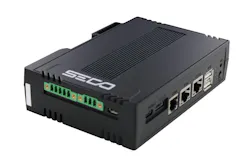
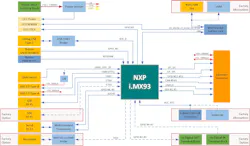
At the core of the DIN-mountable Modular Link is a powerful i.MX 93 applications processor from NXP. Featuring two Arm Cortex-A55 processors running at up to 1.7 GHz, it’s paired with up to 2 GB of LPDDR4 memory and a 32-GB eMMC 5.1 mass storage device.
Supporting edge-AI tasks is the on-chip, 0.5-TOPS Arm Ethos U-65 neural processing unit (NPU) to handle basic inferencing or even relocating some cloud AI activities locally. Measuring 140 × 96 × 36 mm, the MX93 is two DIN wide. It’s specified for operation over the -20 to +70°C temperature range and operates from a 12- to 36-V power source.
Connecting to Sensors and Networks
For connectivity and interfacing, two RJ45 Gigabit Ethernet connectors are available, complemented by an optional Wi-Fi module with two external antennas (802.11 ac/a/b/g/n) and Bluetooth 5.0. And, if needed, the Mini PCIe full-size card slot can be fitted with an optional LTE modem.
Two USB 2.0 Type-A connectors are also implemented, with one supporting USB-OTG. The RJ12 connector can be configured in software as an RS-232, RS-422, or RS-485 interface, while a USB Type-C connector offers access to a UART debugging interface. Finally, two digital outputs and four digital inputs are optionally available via terminal blocks.
Though most gateways are operated headless, there are benefits to attaching a monitor and seeing what’s going on. Supporting this is an optional mini HDMI connector for 1080p at 60-Hz video resolution (Fig. 2).
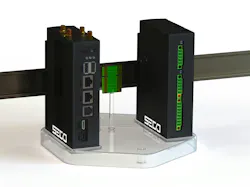
The modular architecture allows system integrators to choose the optimal interfacing options for each gateway deployment they build. Three Add-On Units are available, with more in development, and customization to individual requirements is also possible.
Attached to the expansion connector, the units offer either four optoisolated serial interfaces, eight optoisolated general-purpose I/Os, or a combination of both (Fig. 3). This provides access to the CAN interface alongside the serial ports, supporting the protocols needed in industrial automation and building management systems (BMS).
Backed Up by Software
With the optimal gateway hardware selected, the development team needs to configure the software to their application’s needs. Each use case brings its own challenges, ranging from real-time monitoring, data analysis, and control to support for application-specific communications standards such as BACnet, MQTT, and OPC-UA. Other obstacles include provisioning, monitoring the status of multiple gateways, managing devices, and monetization.
Recognizing the challenges of implementing Industry 4.0 and the upcoming transformation to Industry 5.0, SECO developed the Clea software suite.
Most users begin with Clea OS, an open-source Yocto Project operating system developed in-house for smart gateways with out-of-the-box security. This embedded Linux framework enables developers to build and deploy IoT infrastructure without having to deal with issues such as device management and how to implement secure over-the-air (OTA) updates. It implements remote access and command execution along with real-time device monitoring and status tracking. AI models can also be deployed and managed for low-latency inferencing on hardware accelerators.
Support for standard secure-boot mechanisms is included as well. It will comply with cyber resiliency standards such as software bills of materials (SBOMs) in the future.
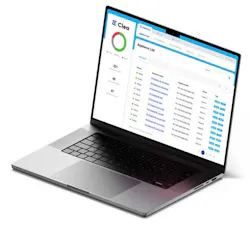
Data visualization is provided by the optional telemetry platform Clea Portal (Fig. 4). Its intuitive interface simplifies access to real-time data with a web-based IoT front-end. With minimal coding effort, it can be extended to meet an application’s needs, while a monetization framework supports the deployment of value-added subscription services. Alternatively, it’s possible to develop a custom front-end.
Fanless Industrial Gateway for Retrofitting and New Deployments
Regardless of the industry, businesses are compelled to make their systems smarter. Operational data must be collected and remote diagnostics implemented with a dashboard that provides clear visualization for analysis. And AI is becoming more prominent, not just in the cloud but at the edge, supporting low-latency decisions based on data trends.
On that front, the SECO Modular Link MX93 offers a fanless industrial PC that can be deployed more economically than a traditional x86 gateway. Thanks to its modular design, the number of I/Os and serial interfaces can be scaled as required, making it suitable for retrofitting in industrial automation systems as well as in smart-metering applications, HVAC, and smart buildings.
About the Author
Francesco Vaiani
Senior Product Manager, SECO
Francesco Vaiani is Senior Product Manager at SECO spa. He brings experience from previous roles at SECO Mind, AIDILAB s.r.l., Officina Profumo - Farmaceutica di Santa Maria Novella, and Centrica. Francesco holds a 2004 - 2010 Scienza e teoria dell'informatica in Scienze naturali fisiche e matematiche from the Università degli Studi di Siena.