UWB for the IIoT: RTLS, FiRa Security, and omlox Location Fabrics
What you'll learn:
- What is UWB and why does it fit harsh industrial IoT environments?
- UWB RTLS as a location fabric for factories and warehouses.
- Practical design considerations for engineers.

Ultra-wideband (UWB) is rapidly becoming a foundational radio for industrial IoT (IIoT) because it adds precise, secure distance and location — not just connectivity — as well as short-range radar sensing of nearby people and objects. That centimeter-scale spatial awareness enables real-time location system (RTLS) platforms that can track tools, pallets, vehicles, and people in real-time, even in RF-hostile factories and warehouses
Defining UWB and How It Fits Harsh IIoT Environments
Conventional industrial wireless standards such as Wi-Fi, BLE, and proprietary sub-GHz were built for connectivity and telemetry, not high-integrity positioning. UWB, in contrast, uses very short, low-power pulses spread over several hundred megahertz of bandwidth, and it measures true time of flight between tags and anchors or gateways (Fig. 1).
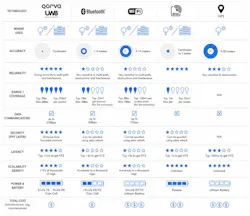
The same nanosecond-scale pulses and wide bandwidth that enable centimeter-level ranging also let UWB act as a short-range radar, detecting motion and human presence from changes in the channel impulse response.
Such an architecture brings several engineering advantages in a metal-heavy plant:
- Multipath resilience: Nanosecond-scale pulses and wide bandwidth let UWB resolve individual paths in time. Thus, the receiver can lock onto the first path rather than integrate all reflections as “extra” power, much like RSSI-based systems.
- Centimeter-level accuracy: Time-of-flight and time-difference-of-arrival (TDoA) schemes routinely achieve 10- to 30-cm positioning in cluttered environments, versus meter-scale with BLE/Wi-Fi RSSI.
- High update rates with low latency: Today’s industrial UWB RTLS platforms support sub-100-ms update intervals for hundreds or thousands of tags, which is critical for material-flow automation and both automated guided vehicle (AGV) and autonomous mobile robot (AMR) safety.
- RF coexistence: UWB’s low-power spectral density and operation in dedicated bands allow it to coexist with Wi-Fi, cellular, and private 5G without adding undue interference.
For design engineers, this means UWB can be layered into brownfield plants where dense Wi-Fi, VHF radios, and inverter noise already exist, without significant RF redesign.
UWB RTLS as a Location Fabric for Factories and Warehouses
When you can reliably answer “where?” for every tagged object, RTLS stops being a niche tracking tool and becomes a shared infrastructure service. Vendors now talk about a “location fabric” that feeds manufacturing execution systems (MES), warehouse management systems (WMS), safety systems, and digital-twin analytics from a common UWB-powered layer.
Typical industrial RTLS architecture:
- UWB tags on tools, pallets, work-in-progress (WIP) carriers, forklifts, AGVs, and worker badges.
- Anchors or UWB-enabled access points form a positioning grid across production lines, staging areas, and warehouses.
- A location engine computing positions via two-way ranging (TWR) or TDoA and exposing them through an API or middleware hub.
- Integration into ERP/MES/WMS, safety PLCs, and visualization tools, often via omlox-style hubs that normalize data from multiple location technologies.
Qorvo and partners, such as SICK and Sewio, demonstrate this approach in real deployments, feeding UWB location data directly into industrial software stacks to drive automated decisions. In practice, new use cases become software features, not new RF projects (see table). Once the grid is in place, adding a geo-fence or new flow analytics is mainly a configuration.
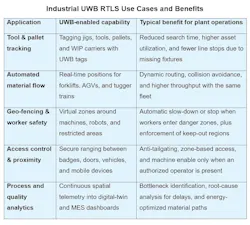
UWB RTLS for Scale in IIoT Networks
Traditional UWB RTLS often delivered excellent accuracy but stalled at pilot scale because it required a dedicated anchor network, separate cabling, and bespoke management tools. The industrial trend now is to treat UWB as another radio on an existing infrastructure platform, typically the plant’s Wi-Fi/OT network.
Key patterns that make UWB scalable in factories and warehouses:
- UWB in enterprise access points or gateways: Embedding UWB radios into industrial access points reuses the existing PoE, backhaul, and management plane, avoiding a “shadow” network.
- Hybrid coverage: High-density anchor grids in critical production areas, supplemented by lower-density coverage in storage or corridors, balances accuracy against deployment cost.
- Edge computing: Local location engines at the cell or line level reduce latency for safety and automation use cases, while aggregated data feeds cloud analytics.
- Open APIs and middleware: omlox hubs and similar middleware expose standardized location streams that multiple applications can subscribe to in parallel, avoiding point integrations.
Case studies in sheet-metal production show that this approach can yield measurable gains, including scrap reduction, fewer line stoppages, and improved Overall Equipment Effectiveness (OEE), purely from better spatial awareness of parts and assets. For electronics design engineers, the implication is that UWB nodes must be designed as part of a managed, IP-centric OT network from day one, not as isolated beacons.
Secure Proximity and Access Control with FiRa
Industrial IoT increasingly needs not only to know the location of something, but to trust that information when it gates safety or access. Secure ranging with UWB is emerging as a building block for that.
The FiRa Consortium profiles the IEEE 802.15.4z UWB PHY/MAC and defines higher-layer procedures for secure ranging, including cryptographically protected scrambled timestamp sequences and dynamic session keys. These measures harden UWB links against distance-shortening attacks that could otherwise spoof proximity and unlock a door or enable a machine when a tag is farther away.
For industrial UWB designs, FiRa-compliant secure ranging enables:
- Zone-based access control where doors, tool cribs, and vehicle chargers only authorize when a badge or smart device is verifiably within a defined radius.
- Machine interlocks that require both correct credentials and physical presence near the HMI or safety gate, without deploying separate RFID or keyed switches.
- Peer-to-peer proximity alerts between workers and vehicles are computed locally with cryptographic integrity.
Because secure-ranging functions are often implemented in the UWB modem’s root of trust and associated secure elements, hardware engineers must factor in key storage, secure boot, and firmware update mechanisms early in platform selection.
Open Standards: omlox and Multi-Vendor Ecosystems
Industrial users are wary of being locked into a single RTLS stack spanning tags, infrastructure, and software. The omlox and FiRa initiatives respond to that by defining how UWB and other positioning technologies interoperate:
- omlox: An open locating standard that defines a core zone (where UWB and other technologies generate position), an omlox hub for normalization, and northbound interfaces for applications. It explicitly supports multi-vendor anchors and tags, plus hybrid technologies such as RFID and BLE, under one location fabric (Fig. 2).
- FiRa: A consortium standardizing secure UWB ranging profiles, certification, and interoperability so that tags, phones, and infrastructure from different vendors can reliably range and exchange secure proximity data.

For design engineers, these standards change part selection criteria. Instead of choosing between an all-in-one proprietary stack and rolling your own RTLS, you can select UWB transceivers, SoCs, and modules that are omlox- and FiRa-aligned and know they will integrate into a larger ecosystem. In turn, it reduces the risk that a single vendor’s roadmap will constrain your long-term IIoT platform.
Practical Design Considerations for Engineers
Translating all of this into a board-level or module-level design requires a few pragmatic decisions:
- Radio and coexistence: Select UWB components that support the required channels, regional regulations, and coexistence mechanisms with 2.4-GHz and sub-GHz radios on the same node.
- Power and update rate tradeoffs: For battery-powered tags, position update rate, TWR/TDoA scheme, and sleep strategy will dominate life. Industrial tags often vary between “always-on” for safety and “duty-cycled” for tools or pallets.
- Form factor and ruggedization: Enclosures must survive metal chips, vibration, chemicals, and wash-down. Antenna placement is critical when tags are mounted on large conductive objects.
- Security and lifecycle: Secure provisioning, over-the-air firmware updates, and integration with plant IAM systems are essential if UWB tags double as access-control credentials.
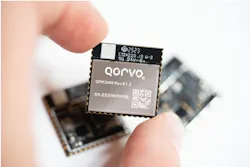
With respect to module selection, high levels of integration minimize cost, board space requirements, and design time. Qorvo’s QPK3000 is a good example of an integrated UWB device that combines simple integration with guaranteed interoperability (Fig. 3).
Engineers who design with these constraints in mind can deliver RTLS endpoints that slot cleanly into omlox-style ecosystems and support years of incremental application roll-out, rather than one-off pilots.
About the Author
Alexis Bizalion
Director, Product Marketing & Enablement, Qorvo
Currently serving as Director of Market Requirement & Customer Enablement at Qorvo Inc., Alexis Bizalion leads initiatives in connectivity solutions, focusing on ultra-wideband technology. Prior roles include Head of Business Development and Partnerships at Sevenhugs, a firm acquired by Qorvo, and co-founder of TokenChanger, a platform for financial DApps.
He holds a Master in Science with a focus on Entrepreneurship from NEOMA Business School and has participated in the HAX Boost Program.