Greek Ground Station Speeds Optical Data Transmissions
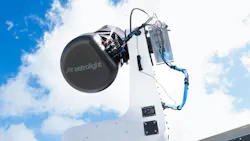
Astrolight completed commissioning of its Holomondas Optical Ground Station (OGS) in Greece this March. The ground station supports Greek In-Orbit Demonstration and Validation (IOD/IOV) missions, providing high-throughput, laser-driven optical communications with orbiting satellites.
Developed as part of the PeakSat project to create a space-based quantum-communications network with the Holomondas OGS Aristotle University of Thessaloniki, creation of the OGS has been backed by the European Space Agency (ESA) and the Greek Ministry of Digital Governance.
The Holomondas site (see image above) at the Holomon Astronomical Station on the slopes of Mt. Holomon (Chalkidiki, Greece) was originally an astronomical observatory. Astrolight upgraded the site by equipping it with laser communications equipment, including an 808-nm laser beacon and C-band optical receiver. With precision laser-beam alignment, the systems achieve optical data communications at speeds to 2.5 Gb/s.
Astrolight developed the OGS’s core optical system and supporting calibration technology to maintain high-speed communications even during adverse environmental conditions and mechanical shifts in equipment alignment.
Laurynas Maciulis, co-founder and CEO of Astrolight, noted, “We are happy to apply our technical expertise to commission the Holomondas station and support the Aristotle University of Thessaloniki’s efforts to advance Greece’s and Europe’s optical communication infrastructure.”
He added, “By providing an end-to-end communication system, with ground and space segments designed to work together from the start, we helped streamline the mission’s path from integration to in-orbit testing.
Learn more about optical communications

 5 G Fiberoptics Dreamstime L 184164407
 5 G Promo
About the Author
Jack Browne
Technical Contributor
Jack Browne, Technical Contributor, has worked in technical publishing for over 30 years. He managed the content and production of three technical journals while at the American Institute of Physics, including Medical Physics and the Journal of Vacuum Science & Technology. He has been a Publisher and Editor for Penton Media, started the firm’s Wireless Symposium & Exhibition trade show in 1993, and currently serves as Technical Contributor for that company's Microwaves & RF magazine. Browne, who holds a BS in Mathematics from City College of New York and BA degrees in English and Philosophy from Fordham University, is a member of the IEEE.