Next-Gen RF Transceivers Deliver Seamless Earth-to-Space Connectivity
What you'll learn:
- How integrated RF transceivers serve two main functions.
- Considerations when designing satellite communication systems.
- Trends in integrated RF receivers for satellite communications.

The vision of 6G non-terrestrial networks (NTNs) is truly fascinating. They aim to seamlessly integrate satellites, high-altitude platform stations, unmanned aerial systems, and terrestrial networks into a unified global system. Ultimately, NTNs intend to provide uninterrupted, high-speed connectivity and mobility anywhere on Earth, from dense cities to rural areas, to remote oceans, and even deep space.
On the other hand, satellite communication is not something new. Since the first geostationary orbit (GEO) satellites of the 1960s proved that space-based relays could deliver global coverage, legacy satellites have been mostly GEO- or medium-Earth-orbit (MEO)-based, using proprietary technologies and providing narrowband voice and data services.
Today, the satellite communications industry is undergoing its most significant transition. This shift includes low-Earth-orbit (LEO) satellite constellations that offer dramatic cost savings, software-defined payloads, and electronically steerable antenna terminals. The industry is also adopting direct-to-device (D2D) connectivity and Third Generation Partnership Project (3GPP) NTN standardization.
These innovations are transforming satellite communications from a niche solution into scalable broadband infrastructure that complements and extends terrestrial networks worldwide.
This article examines the fundamental system design factors, challenges, trends, and solutions for satellite communications systems from the perspective of integrated radio-frequency (RF) transceivers, an essential component to bridge the real and digital worlds.
Integrated RF Transceivers
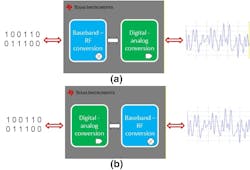
Before diving into the satellite communication system, let’s begin with a primer about integrated RF transceivers, which serve two main functions: converting signals between baseband and RF, and converting signals between the digital and analog domains. High-speed analog-to-digital and digital-to-analog converters (ADCs and DACs), typically sampling data at gigasamples per second, are at the core of the integrated RF transceivers used in communication infrastructures.
There are two types of integrated RF transceiver architectures. In the direct RF sampling architecture, conversion between the baseband and RF occurs in the digital domain (Fig. 1a). In a zero-intermediate frequency (ZIF) architecture, the conversion between the baseband and RF takes place in the analog domain (Fig. 1b).
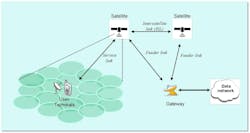
Depending on the design, the satellite payload may be transparent (providing no onboard processing and simply “repeating” with filtering and amplification) or regenerative (incorporating onboard processing capabilities such as coding and decoding, modulation and demodulation, switching, and routing). The satellite payload connects to the gateway through a feeder link, and the gateway interfaces with the back-end data network.
Like many other applications, these building blocks have different functions and constraints, driving different design requirements.
Fundamental Satellite Communication System Design Factors
There are several considerations when designing satellite communication systems that are related to, but still differ from, terrestrial networks:
The RF spectrum and signal bandwidth
The legacy mobile satellite service (MSS) spectrum, including the L-band and S-band, remain in use for both GEO and LEO systems. Recent 3GPP work standardized operation in the MSS bands under the NTN framework, enabling both traditional MSS operators and emerging LEO constellations to support 5G devices directly.
Regulatory developments, such as those from the Federal Communications Commission in the United States, permit satellites to operate within the terrestrial mobile service spectrum to provide supplemental coverage from space (SCS), subject to certain restrictions. Current SCS allocations reside below 3 GHz.
Direct-to-device (D2D) and Internet of Things services typically use the MSS and SCS bands because lower frequencies provide better propagation characteristics for communicating with small, low-gain user devices such as smartphones. The signal bandwidth is often only a few or tens of megahertz.
Broadband satellite services generally use the Ku- and Ka-bands because of their larger available bandwidth, typically hundreds of megahertz.
The feeder links connect the satellite payload and the gateway. Because the gateway serves as the primary aggregation point for all user traffic entering and leaving the satellite network — and needs to handle network functionalities such as rapid handovers — the gateway must be able to support ultrawide gigahertz bandwidths. It typically operates in the Ku-band, Ka-band, Q-band, or V-band.
Noise and interference
Terrestrial networks require base stations to detect weak signals in the presence of strong blockers (interferers). In macro base-station deployments, blockers may exceed the preferred signal by ≥ 50 dB, necessitating low receiver noise figures, high linearity, and large spurious-free dynamic range.
In satellite systems, propagation distances on the order of hundreds to thousands of kilometers introduce significant propagation losses. These include free-space losses, atmospheric attenuation, and shadowing. Consequently, the received signal at the satellite antenna is typically below the noise floor, and large phased antenna arrays provide the necessary directivity gain for signal-to-noise recovery.
As a result, NTN systems are primarily noise-limited, whereas terrestrial networks are generally interference-limited.
Phased-array antenna size
In satellite communication systems, because of the long propagation distance, satellite links require highly directive antennas to overcome path losses and minimize unwanted emissions. Large phased-array antennas with advanced beamforming enable the generation of numerous high-gain spot beams and provide null-steering capability for interference suppression.
Terrestrial systems also employ massive multiple-input multiple-output (MIMO) technology. However, arrays typically consist of only tens of elements in the FR1 bands and a few hundred elements in the FR2 bands. In contrast, satellite payload arrays may include several thousand elements, with even larger arrays used at ground stations.
Beamforming architecture
Beamforming is essential in satellite communication networks. The scale of satellite phased-array antennas requires careful optimization of the beamforming architecture, based on the system requirements of cost, power consumption, beamsteering flexibility, and pointing accuracy.
Satellite payloads and gateways frequently adopt hybrid and digital beamforming solutions, whereas user terminals employ analog beamforming solutions, mostly because of the cost and small number of beams required.
In comparison, terrestrial FR1 systems often utilize fully digital beamforming, enabled by smaller array sizes and more favorable power budgets.
Size, weight, and power
Satellite payloads face stringent power constraints. As a result, power efficiency and a low-power-dissipation RF architecture are more important considerations than in terrestrial base stations, which have access to stable and abundant power sources.
While size and weight are important for terrestrial base stations, they’re even more important for satellite payloads, because they directly affect nearly every aspect of spacecraft performance and cost.
Launch vehicles impose strict mass and volume limits. The launch cost is directly proportional to the payload weight. Larger or heavier structures require stronger mechanical reinforcement to withstand vibration and shock during launch, which further adds mass.
Once in orbit, increased size and weight raise the satellite’s moment of inertia, demanding larger attitude-control hardware and more propellant, which can reduce mission lifetimes. Thermal and power management also become more challenging.
Collectively, these factors make compact, lightweight payload designs essential for achieving goals related to cost, endurance, and operational lifetimes in satellite systems.
Reliability in space
Satellite systems must meet strict reliability requirements because it’s not possible to perform in-orbit maintenance. Depending on mission objectives, designs may incorporate space-grade components, radiation-hardened devices, or redundant commercial-grade electronics to achieve a target lifetime and reliability.
Technology Trends
I see these trends developing in integrated RF receivers for satellite communications:
- The direct RF-sampling architecture: Compared to a zero-IF architecture, direct RF sampling-based RF transceivers offer many advantages. For example, they’re highly configurable and flexible with multiband support; support fast frequency hopping; and require no in-phase-quadrature mismatch, local oscillator leakage, or DC offset calibration. Since satellites are most likely not restricted to one particular country or region while orbiting around the earth, it’s necessary for the same satellite to be able to support multiple different frequency bands and quickly hop over multiple frequencies. A direct RF-sampling architecture is a perfect fit.
- High channel density: With the large size of a phased-array antenna, especially when using digital or hybrid beamforming, each satellite payload needs numerous transceiver channels. RF transceivers with high channel density can significantly reduce size and weight, enabling a compact and lightweight design. For example, TI’s AFE8190, the industry’s first 16-channel RF transceiver, integrates 16 transmitters, 16 receivers, and four additional ultrawideband transceivers for digital-predistortion feedback observation in one device.
- Low power consumption and high power efficiency: Two equally important aspects ensure that every watt matters in satellite communication design, especially for satellite payloads. First, design innovations and process minimization help reduce the active device-level power consumption. Second, system-level features can be implemented to improve the overall system power efficiency. Integrating digital predistortion within the RF transceiver, such as TI’s AFE7769D, makes it possible to drive power amplifiers harder toward the saturation region for better system power efficiency, or adopt high-efficiency power amplifiers with gallium nitride. It's also beneficial to include and enable power-saving features when the satellite travels over low- or no-traffic regions.
- Ultrawideband (gigahertz) support for feeder links: With the increase in satellite constellations and service subscribers, it’s inevitable that the gateways need to support growing capacity, demanding more bandwidth. Direct RF-sampling-based transceivers are well positioned to support the ultra-wide bandwidth, enabled by the high-speed data-converter core.
- Beamforming integration: For many reasons, beamforming technology has gradually moved from analog to digital or hybrid (especially for payloads and gateways), including true multibeam per aperture, finer precision, wide-beam bandwidth support, fast adaptive beamtracking, and better spectral agility. Integrating digital beamforming into an analog front end offloads the field-programmable gate array computational and memory resources, reduces the data throughput, and provides overall power dissipation optimization.
- Space reliability: Space reliability also includes giving options to meet the various space radiation tolerance requirements and being clever on how to introduce space redundancy. For example, TI’s AFE7950 and AFE7950-SP are pin-compatible devices offering different radiation tolerance.
Conclusion
As NTNs move from vision to reality, satellite communications are entering an exciting period. For RF transceiver vendors, NTN offers opportunities to shape the foundation of next-generation communication networks.
Higher integration, better power efficiency, smarter beamforming, and more flexible RF architectures will be essential enablers of global, resilient, and seamless NTN coverage. Integrated RF transceivers like the AFE8190 and AFE8030 can help solve these challenges with a high level of integration and ease of design for small-form-factor payload radios.
Read more articles in this special report
 cellular_dreamstime_l_73406034
About the Author
Sanjay Pithadia
Marketing and Applications Manager, Wireless Infrastructure, Texas Instrument
Sanjay Pithadia is marketing and applications manager, Wireless Infrastructure, at Texas Instruments.
Related
 Leaders Logo
Leaders relevant to this article: