Seamless Connectivity Everywhere: How NTNs Will Transform 6G
What you'll learn:
- The promise of non-terrestrial networks.
- 3D network architecture and the backbone of 6G NTNs.
- Opportunities and challenges with NTNs.

Non-terrestrial networks (NTNs) have long been pitched as the answer to connectivity gaps, including remote communities, disaster zones, and industries operating beyond terrestrial reach. In the 6G era, NTNs promise to deliver not just coverage, but resilience and inclusivity.
What’s changed? They’re no longer theoretical. Direct-to-device connectivity is moving from concept to reality, with multiple players launching services that extend mobile coverage beyond terrestrial limits. Dead zones are no longer the end of the conversation. Phones can keep messaging, pulling weather information, and performing signaling to help when towers disappear.
From Orbit to Everywhere
The journey from a single satellite in 1957 to thousands in orbit today sets the stage for the rise of NTNs. Current projections show tens of thousands of active satellites (Fig. 1), many in low Earth orbit (LEO), creating a dense mesh for global connectivity.

Industry momentum is accelerating: SpaceX has demonstrated direct-to-cell messaging, AST SpaceMobile is partnering with AT&T and Verizon for global coverage, and Apple’s Globalstar integration offers emergency messaging on iPhones. By late 2024 and throughout 2025, carriers began rolling out real offers such as nationwide texting in New Zealand, Canada-wide trials, curated data apps in Japan, and U.S. expansion with mainstream apps like WhatsApp and Google Maps integrated into OS-level SAT mode.
This tipping point combines policy clarity under the Federal Communications Commission’s (FCC) Supplemental Coverage from Space (SCS) framework with international spectrum harmonization led by the International Telecommunication Union (ITU) and ongoing 3rd Generation Partnership Project (3GPP) standardization. In addition, technical advances now allow satellites to act as roaming cell sites for ordinary handsets.
3D Network Architecture: The Backbone of 6G NTN
Unlike 5G, where NTN was an add-on, 6G envisions NTN as a Day 1 native component of a unified 3D network architecture spanning terrestrial, aerial, and space layers. This multilayered design integrates:
- LEO, medium Earth orbit (MEO), and geosynchronous orbit (GEO) satellites
- High-altitude platforms (HAPs)
- Unmanned aerial vehicles (UAVs)
The result would be seamless handover across layers, enabling robust coverage and advanced use cases such as autonomous mobility, maritime communications, and emergency response. This architecture supports multiconnectivity, dynamic spectrum sharing, and AI-driven orchestration across all domains.
Transformational Applications
Direct-to-Device Connectivity
Imagine pulling out your phone in a desert or on a ship and having the same coverage you expect downtown. This becomes possible in 6G. Early deployments support messaging and essential apps, with voice and richer data on the horizon as spectrum and satellite density scale.
Autonomous Mobility and Drones
NTNs will enable drones to inspect pipelines across remote terrain and vehicles to navigate safely in areas without terrestrial towers. Reliable NTN links will support precision agriculture and urban air mobility, where machines depend on continuous data streams.
Disaster Relief and Public Safety
When terrestrial networks fail during hurricanes or wildfires, NTNs can activate instantly, providing life-saving communications for first responders. This resilience is why operators are integrating satellite access as roaming, ensuring continuity without user intervention.
The Enabling Stack for NTN-Driven 6G
Delivering seamless NTN-TN integration requires a portfolio of technologies:
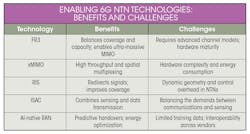
- Frequency Range 3 (FR3) spectrum: The sweet spot for 6G, balancing coverage and capacity better than millimeter-wave (mmWave) frequencies while offering more bandwidth than sub-6-GHz.
- Extreme MIMO (xMIMO): Thousands of antennas forming ultra-narrow beams to maximize spectral efficiency and reduce interference.
- Reconfigurable intelligent surfaces (RIS): Smart reflectors that redirect signals around obstacles, mounted on buildings or even satellites.
- Integrated sensing and communication (ISAC): Networks that sense and communicate simultaneously, enabling cooperative navigation and environmental awareness.
- AI-native radio access network (RAN): Networks that learn and adapt, optimizing spectrum, predicting handovers, and balancing energy in real-time.
Together, these technologies form the backbone of an intelligent, adaptive NTN-enabled 6G ecosystem, but each technology provides unique advantages and challenges, as highlighted in the table.
Industry experts caution that these technologies demand rigorous validation under real-world conditions, including Doppler effects, latency, and synchronization challenges unique to NTNs.
Industry Acceleration: Key Players
SpaceX, AST SpaceMobile, and Apple illustrate different strategies shaping the NTN’s future.
- SpaceX focuses on mobile satellite service (MSS) spectrum acquisitions and constellation density for global scalability.
- AST SpaceMobile leverages partnerships with major carriers and aims for high-capacity direct-to-device links.
- Apple integrates NTNs for emergency messaging, prioritizing user experience over high data rates.
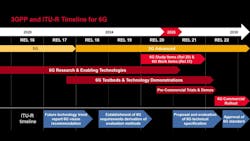
Alignment with 3GPP standards, which started in Release 17 for NTN basics and evolved further in Release 18/19 for mobility and regenerative payloads, ensures interoperability and allows satellites to function as part of the radio access network (RAN) rather than a bolt-on.
Standards Roadmap: Looking Ahead to Release 20 and 21
While Releases 17 and 18 laid the foundation, 3GPP Releases 20 and 21 will advance NTN integration further:
- Release 20 (2025–2026): Study phase for multi-orbit architectures, AI-native air interfaces, and advanced spectrum sharing.
- Release 21 (2027–2028): Normative specifications for regenerative payloads, seamless NTN-TN convergence, and IMT-2030 compliance.
These releases align with the ITU’s IMT-2030 timeline, targeting commercial 6G deployments by 2030 (Fig. 2).
NTN Challenges Ahead
Despite progress, NTN faces hurdles:
- Spectrum harmonization: Coordinating satellite and terrestrial operators across FR3 bands is complex, akin to managing air traffic at dozens of airports.
- Standardization: Multi-vendor interoperability is critical; without common interfaces, NTN risks fragmentation.
- Hardware constraints: Satellites operate under tight power and thermal budgets, making efficiency paramount.
- Business models: Constellations cost billions. Success depends on proving value across consumer, enterprise, and public safety markets.
Design and Modeling for Success
Lessons from 5G underscore the need for practicality. For NTN in 6G, that means:
- Energy efficiency: Networks that “sleep” during low traffic and satellites that dynamically adjust beams.
- Zero-trust security: Continuous authentication and encryption across borders and industries.
- Digital twins: High-fidelity virtual models to test real-world conditions before expensive launches, simulating interference, weather, and cyberattacks.
Validating NTN performance for 6G requires more than traditional link testing. Advanced modulation schemes combined with high-fidelity digital twins allow engineers to emulate complex orbital dynamics, Doppler shifts, and multilayer interference before hardware deployment.
These virtual environments replicate real-world conditions, enabling optimization of waveform design, power efficiency, and latency. By integrating AI technology into these simulations, developers can predict performance tradeoffs and accelerate innovation while reducing costly trial-and-error in orbit.
Orbit to Opportunity
NTNs aren’t just about satellites, they’re about equity, industry, and resilience:
- Equity: Extending digital services to underserved communities.
- Industry: Enabling efficiencies in agriculture, logistics, and manufacturing.
- Resilience: Keeping societies connected during disasters.
With multiple players driving innovation and global standards shaping interoperability, NTNs are poised to become a baseline expectation for connectivity in the 6G era. For engineers, the mandate is clear: Design systems that are visionary yet grounded, meaning efficient, secure, and interoperable from day one.
Read more articles in this special report
 cellular_dreamstime_l_73406034
About the Author
Jessy Cavazos
6G Solutions Lead, Keysight Technologies
Jessy Cavazos joined Keysight's Industry Solutions Marketing team in January 2019 with a focus on 5G. Prior to that, Jessy was the Industry Director for the Test & Measurement practice at Frost & Sullivan. She joined the global consulting and market research company in 2002 and tracked the Test & Measurement industry for more than 15 years.
Jessy has authored numerous market studies highlighting key opportunities and disruptive trends and has been published in industry-leading publications. She holds a bachelor’s degree in international business from the Institut de Formation Internationale located in Rouen, France, now part of the NEOMA Business Schools.
Related
 Leaders Logo
Leaders relevant to this article: