Catching Up at the 2026 IMS Exhibition
What you'll learn:
A plethora of advances in an array of tech sectors were on display at IMS 2026, including:

Microwave/RF electronics markets have expanded rapidly in recent years, growing from an early base devoted to defense-oriented radar systems. Keeping up with changing companies and technologies is something that's typically done on an annual basis, at the IEEE International MTT Symposia.
Year after year, the event alternates from east to west coast of the U.S., with the 2026 edition and its exhibition held at the Thomas M. Merino Convention and Exhibition Center in the Seaport section of Boston, Mass. Visitors to a crowded exhibition hall had the opportunity in three days (June 9-11, 2026) to see old friends and make new acquaintances as they made stops among the more than 400 exhibitor booths.
In addition to company representatives, booths featured descriptions of capabilities and services as well as examples of hardware and software, from the smallest integrated circuits (ICs) to sophisticated test-and-measurement equipment and processing equipment. Following a general trend in electronics, the industry is developing products that may not be lower in cost, but they're packing increased functionality and performance into smaller sizes.
A Wide Range of PCB Substrate Materials
The wide range of technologies required for modern electronic products was represented on the 2026 MTT-S Exhibition show floor, from basic building-block circuit materials to complete test-and-measurement systems.
Designers in need of circuit laminate and prepreg materials, for example, could find halogen-free materials for printed-circuit boards (PCBs) at Isola. With low loss at microwave frequencies, Astra MT77 laminate materials feature a glass transition temperature (Tg) of typically +200°C and a decomposition temperature (Td) of +360°C. The low dielectric constant (Dk) of 3.00 remains stable between –40 and +140°C through W-band frequencies.
And Astra MT77 has a low circuit material dissipation factor (Df) of 0.0017, serving as a practical alternative to more costly polytetrafluoroethylene (PTFE) circuit materials.
Isola’s TerraGreen 400G circuit material, also halogen-free, was on display as well, providing an excellent circuit base for high-speed digital and millimeter-frequency PCBs. The lead-free-compatible circuit material, which can be processed with standard PCB equipment, meets UL 94 V-0 requirements. It has a Tg of +200°C and a Td of +380°C with slightly higher Dk of 3.15 and Df of 0.0018 with low loss for RF/microwave circuits.
Additional high-quality circuit-material suppliers could be found throughout the MTT-S show floor, including Rogers Corp. Rogers displayed its popular RO3000 series low-loss circuit materials for RF/microwave applications, but also acknowledged the need to support millimeter-wave circuits.
For example, the company helped visitors understand the use of its RO4830 Plus thermoset laminates for millimeter-wave applications, such as automotive radar systems. Free of woven glass, the materials have typical Dk of 3.03 at 77 GHz.
Formed with low-loss thermoset resin and low-profile electrodeposited (ED) copper foil, the laminates support microstrip PCBs with transmission-line insertion loss of 1.5 dB/in. from 76 to 81 GHz. They serve well as the cap layer on multilayer PCBs assembled with other circuit materials, such as FR4.
Working with dielectric materials, Amphenol Printed Circuits presented examples of large-format PCBs. One development was a PCB about 40 in. long used as a patch antenna array. By combining materials with different electrical and mechanical characteristics, including Dk and Df values, the cross-polarized, dual-feed patch array can combine thousands of devices and circuit elements at Ku-band frequencies. Despite the complexity, the firm also promotes its capabilities to design and assemble advanced PCBs in a matter of days.
International Manufacturing Services Inc. (IMS) shared examples of the ability to handle higher heat levels when developing smaller PCBs at higher power levels.
As IMS has learned in the design and production of its high-power RF/microwave attenuators and ThermaBridge thick-film thermal management devices, PCB thermal management must be carefully considered at higher power levels; thermal energy on a PCB often must flow away from passive as well as active components. While active components such as amplifiers will generate heat, especially at lower efficiency levels, passive components such as attenuators and filters can also generate heat, especially with increasing signal power levels for smaller PCBs.
The ThermaBridge devices, supplied in SMT packages, are based on aluminum-nitride (AlN) substrates. By inserting the devices in critical heat paths within PCB layouts, they can withstand high voltages and power levels and dissipate heat that would otherwise degrade the performance and operating lifetime of a PCB. The devices add little to total circuit size, weight, and power (SWaP) and are available for substrate thicknesses of 0.010, 0.015, 0.025, and 0.040 in.
Not far from IMS, a company with the same initials — Intelligent Manufacturing Solutions — explained how the speed of its rapid prototyping could contribute to success when time-to-market was a key consideration. The firm showed examples of highly detailed PCBs assembled quickly. And its prototyping capabilities are aided by experienced in-house engineering and a New England (Manchester, N.H.) facility capable of providing overnight delivery of custom prototypes anywhere in the continental U.S.
Supporting a wide range of PCB markets including aerospace and defense (A&D), automotive, industrial, and medical markets and backed by numerous accreditations, including AS9100, ISO 9001, RoHS compliance, and UL certification, Intelligent Manufacturing Solutions has turned PCB drawings into designs in as little as 24 hours.
Choosing Components For Wireless Systems
As PCBs are designed for smaller sizes, suppliers of components try to keep pace, whether using discretes or IC technologies. Analog Devices caught the attention of many visitors not for the packaged IC but for the multilayer PCB assembly used to demonstrate it. The IC, the ADL5961 vector-network-analyzer (VNA) front-end IC, once occupied a good portion of a rackmount instrument. Now, though, it now fits within a 3- × 4-mm, 26-lead, land-grid-array (LGA) package while covering the broad frequency range of 9 kHz to 26.5 GHz.
The VNA front-end IC includes a resistive bidirectional bridge, downconversion frequency mixers, programmable intermediate-frequency (IF) amplifiers and filters, and a local-oscillator (LO) interface. The device’s primary transmission line suffers only 1.1-dB loss at 9 kHz, rising to only 1.8-dB loss at 26.5 GHz.
The front end is designed to cover the broad measurement range connected to an additional 6-GHz frequency synthesizer. With the small size of the VNA IC, a multichannel analyzer can be assembled within a lightweight, compact module for ease of integration into other systems.
A smaller semiconductor supplier, Integra RF Power Devices Technologies Inc., generated excitement at the MTT-S exhibition by introducing the model IGN1030S10000 +150-V DC GaN-on-SiC transistor. It's capable of providing 10 kW of pulsed output power at L-band frequencies from a single device. The high-voltage transistor enables radar designers to aim for higher power levels with less amplifier stages and less power-combining passive components.
Visitors to Integra’s booth saw examples of many other high-power devices, including silicon bipolar and +100-V DC GaN-on-SiC power transistors.
ATEK Midas drew attention with its ATEK563P5 MMIC driver amplifier, which sports 12-dB gain from 0.2 to 24.0 GHz. The self-biased amplifier, well-suited for electronic-warfare (EW), communications, radar, and test applications, delivers +27- to +30-dBm output power across the frequency range.
Based in Karnataka, India, Fermionic Design Inc. impressed visitors with its FD3R4411A four-channel beamforming IC. Designed for X-band frequencies from 8 to 12 GHz, it supports four antennas for transmit and receive functions using time-division-duplex (TDD) operation and provides a 31-dB gain control range with 0.5-dB resolution. The phase-control resolution is 2.8° with 2° accuracy over a 360° phase-control range.
Housed in a tiny BGA package with integrated temperature sensor and power detector, the IC features a four-wire SPI interface for independent gain and phase adjustments to the four channels.
Microchip Technology Inc. presented its PFX and PSX lines of PCIe 6.0 fanout switches for applications requiring a great deal of data movement, such as to and from data centers. Visitors saw examples of how multiple switches could be combined into high-speed data links exceeding 100 Gb/s while also conserving processing power. The firm’s Switchtec PCIe 6.0 fanout switches are fabricated with a 3-nm silicon semiconductor process to help handle the growing demands of artificial-intelligence and machine-learning (AI/ML) applications.
A long-time supplier of YIG-based filters, oscillators, and frequency synthesizers, Micro Lambda Wireless Inc. showed some of its latest wares, including YIG-tuned oscillators operating from 700 MHz to 44 GHz. Sources were available with narrowband and wideband tuning across those frequency ranges, with coaxial connectors and in plug-in package formats, and with the low phase noise typically found in YIG sources.
Fundamental-frequency YIG oscillators reach 22 GHz with as much as +23 dBm of output power . And oscillators with built-in frequency doublers extend the frequency coverage to 44 GHz at reduced output-power levels.
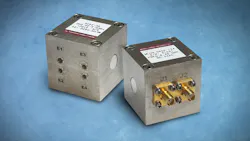
Among its coaxial YIG band-reject filters, for example, standard models in the 120 series cover 6 to 18 GHz, 8 to 20 GHz, and 6 to 20 GHz for applications in telecommunications and testing. Supplied in small cube-shaped packages measuring 1.4 in. on a side (Fig. 1), the filters are available with tuning bandwidths as wide as 80 MHz and notch depths as deep as –80 dBc.
Mini-Circuits displayed a sample of its extensive product lines, including several low-temperature-cofired-ceramic (LTCC) filters such as the BFHK-1432+ LTCC bandpass filter. With a passband covering the popular Ku-band satellite communications (satcom) uplink range of 14.0 to 14.5 GHz, it's also useful for compact test equipment.
The LTCC filter, supplied in a shielded 1812 housing measuring just 4.5 × 3.2 mm, exhibits 3-dB typical passband insertion loss with 60-dB rejection from 100 MHz to 5 GHz and 65-dB rejection from 18.5 to 27.5 GHz. The compact filter can handle as much as 6.3 W of input signal power.
On the active-component side, Mini-Circuits showed some of its many amplifier products, including the TSS-44+ surface-mount-technology (SMT) MMIC amplifier in a 3- × 3-mm SMT package with shutdown function. The 22.0- to 43.5-GHz amplifier offers 15.8-dB gain at 22.0 GHz, 17.6-dB gain at 30.0 GHz, and 10.0-dB gain at 43.5 GHz. Typical noise figure is 3.7 dB at 22.0 GHz, 3.2 dB at 30.0 GHz, and 4.2 dB at 43.5 GHz. The miniature amplifier typically draws 22 mA from a +4-V DC supply.
The firm also displayed examples of its growing lines of test equipment, such as the SSG-44G-RC modular signal generator. The generator delivers as much as +14 dBm CW and pulsed output power from 100 MHz to 44 GHz, and it can be programmed via Windows 7 and later PCs for sequences with pulse widths as narrow as 0.5 µs.
The SSG-44G-RC features low phase noise (typically –105 dBc offset 100 kHz from the carrier) and strong harmonic rejection (typically –30 dBc) with USB and Ethernet control interfaces and a 2.92-mm female output connector.
Nuvotronics showed some of its contributions to PCB densification, such as the PSB1030148 (Fig. 2). The four-channel, 18- to 40-GHz switched bandpass filter bank handles as much as +24-dBm input power per channel, with channels of 17.5 to 24.0 GHz, 23.0 to 29.0 GHz, 28.5 to 35.0 GHz, and 34.0 to 40.0 GHz.
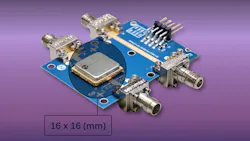
Well-suited for dynamic channel hopping in software-defined radios (SDRs), the switched filter bank combines high-speed switches with the firm’s PolyStrata bandpass filters that feature 1-GHz overlap to achieve better than 75-dB rejection of unwanted signals. The PCB-mountable unit measures 15.8 × 16.3 × 4 mm with switching speeds of 200 ns or better.
Researchers investigating the effects of material characteristics on PCB performance found many useful laser-based processing systems with LPKF Laser & Electronics, including the LPKF ProtoLaser R4. It employs 8-W maximum, 515-nm laser power in a cabinet size of 35.8 × 64.9 × 31.3 in.
The system processor transforms materials such as GaN with dimensions as large as 9.4 × 12.4 × 12.4 × 0.8 in. into circuit layouts as large as 9.0 × 12.0 × 12.4 × 0.8 in. It forms minimum line and spacing dimensions of 35 and 20 µm, respectively, and is capable of processing thin films even on standard circuit materials such as FR4. The system operates under the control of the company’s LPKF CircuitPro software.
In the Wireless World, Test Matters
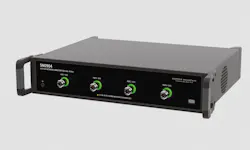
Copper Mountain Technologies offered information about, and demonstrations of, its various test instruments, including antenna test systems and vector network analyzers. One of the company's latest VNAs, the four-port SN0904 (Fig. 3), offers measurement bandwidths of 1 Hz to 300 kHz from 300 kHz to 9 GHz. It provides 1-Hz frequency resolution with dynamic range of 110 dB from 300 kHz to 5 MHz, 135 dB from 5 MHz to 6 GHz, and 122 dB from 6 to 9 GHz.
Surrounded by an exhibition floor with many of the leading suppliers of test-and-measurement equipment and instruments, including Anritsu, Keysight Technologies, and Rohde & Schwarz, Signal Hound showed a growing assortment of affordable test-and-measurement solutions. Among them was its modular spectrum analyzers now available for signal measurements into the millimeter-wave frequency range. Its latest spectrum analyzer, model SM435B, spans 100 kHz to 43.5 GHz.
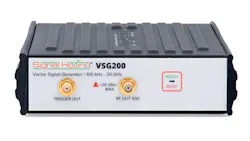
For visitors with measurement requirements beyond spectrum analysis, Signal Hound also demonstrated its broadband VSG200 vector signal generator (VSG) (Fig. 4) and sensitive VNA400 VNA. With a frequency range of 100 kHz to 20 GHz and 40-MHz real-time vector signal bandwidth, the VSG200 offers impressive 200-µs switching speed.
Designers in search of computer-aided-engineering (CAE) tools at the 2026 MTTS found well-attended booths for the leading suppliers, including Cadence Design Systems, Keysight Technologies, and Sonnet Software.
For those in need of models, Modelithics provided insights into the more than 31,000 models of active and passive components in its COMPLETE Library. The model library is compatible with electronic design automation (EDA) tools from leading suppliers, including Keysight Technologies and ADS software, AWR from Cadence and AWR software, and Ansys and its HFSS software.
And for those designing with switches, Global Marketing Manager Kim Otte of Pickering Interfaces offered details on the Microwave Switch Design Tool, available for use on the company's website free of charge.
>>Check out more of our IMS 2026 coverage
 dreamstime_heinerle_32711796
About the Author
Jack Browne
Technical Contributor
Jack Browne, Technical Contributor, has worked in technical publishing for over 30 years. He managed the content and production of three technical journals while at the American Institute of Physics, including Medical Physics and the Journal of Vacuum Science & Technology. He has been a Publisher and Editor for Penton Media, started the firm’s Wireless Symposium & Exhibition trade show in 1993, and currently serves as Technical Contributor for that company's Microwaves & RF magazine. Browne, who holds a BS in Mathematics from City College of New York and BA degrees in English and Philosophy from Fordham University, is a member of the IEEE.
Related
 Leaders Logo
Leaders relevant to this article: