NTN Device Validation Demands Dedicated Test Environments
What you'll learn:
- One common trait between NTNs and terrestrial networks is their adherence to industry standards.
- Satellites present different challenges when designing and manufacturing NTN devices.
- The importance of accurately simulating variables to achieve high-quality evaluation of NTN devices.

Non-terrestrial network (NTN) deployment continues to ramp up to support the ever-growing need for high-speed internet, particularly by extending broadband connectivity in underserved and rural areas. These networks also serve as a level of redundancy for terrestrial networks, as they can provide immediate connectivity when terrestrial networks are damaged or out of commission. To achieve such goals, devices must reliably perform, requiring a dedicated test environment to ensure their operation.
NTNs leverage various platforms to deliver communication services, each with unique characteristics and use cases. As shown in the table, increased altitude leads to broader coverage but also higher latency. These differences directly affect link performance, service continuity, and device design.
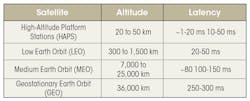
For these reasons, NTNs bring a new level of testing. While many measurements and analysis remain the same as those for terrestrial networks, the considerations change rather dramatically. Engineers need to account for these specific variables when verifying NTN chipsets, devices, and systems.
Standards Guide the Way
One thing NTNs share with terrestrial networks is their adherence to industry standards. 3GPP Release 17 defines the first standardized NTN specifications for both NB-IoT and NR:
- NTN NB-IoT extends Release 13 NB-IoT to satellite links. It supports low-data-rate messaging, asset tracking, and remote IoT connectivity where terrestrial coverage is unavailable.
- NTN NR expands 5G NR operation to satellite systems, enabling higher data rates, messaging, and emerging IoT applications. Enhanced mobility, improved Doppler compensation, and more advanced capabilities continue into 3GPP Release 18.
Spectrum allocation and regulations are also an issue in NTN design. Engineers need to account for ITU specifications, as well as regulatory bodies in different countries, since NTNs transmit across boundaries.
Design Challenges of NTNs
Utilization of satellites presents different challenges when designing and manufacturing NTN devices. Among the considerations are:
Delay and Doppler Shift
One major factor is the inherent delay associated with transmitting and receiving signals because of the extreme distance between a UE and satellites, compared to terrestrial networks. Signals typically travel between 300 m to 10 km in a terrestrial network versus 20 to 36,000 km in an NTN.
Propagation distance in NTNs is significantly longer than in terrestrial networks (hundreds of meters to ~10 km terrestrially versus hundreds to tens of thousands of km in NTNs). This introduces large propagation delays and high Doppler shifts, particularly with LEO satellites moving at ~7.5 km/s (~17,000 mph).
Another major consideration is that movements by non-GEO satellites cause a Doppler shift in signal frequency due to the speed of the satellites. NTN-enabled devices must compensate for delay and Doppler shift in accordance with the 3GPP standard.
Doppler shift can be calculated from the relative speed and frequency between a satellite and a base station. It’s most noticeable with LEO satellites, since their relative speed is larger than that of other orbit satellites.
To correct for Doppler shift, engineers must know the speed and position of the base station/device and the satellite. LEO Doppler can exceed ±40 kHz at 2 GHz. NTN devices must implement the delay and Doppler compensation procedures defined in 3GPP TS 38.211, TS 38.212, and TS 38.213.
Reselection and Roaming
In terrestrial networks, devices switch from one base station to another based on signal strength. This process, called reselection, is more complex for NTNs because of the added factor of requiring precise location information. For example, since LEO satellites travel ~17,000 miles an hour, they go around the earth in about 90 minutes.
Satellites crossing borders and switching operators from different countries also pose design considerations. Therefore, when developing NTN-enabled devices, engineers must ensure that the roaming behavior complies with 3GPP standards, as well as respective government regulatory guidelines. Factors to consider include:
- Satellites move rapidly across the sky, causing frequent cell boundary changes.
- Beam footprints can be extremely large, requiring precise timing and frequency tracking.
- Cross-border coverage introduces additional roaming and regulatory constraints.
Interference
A number of unique conditions contribute to interference in NTNs. Orbital slot allocation for satellites creates interference concerns, especially at LEO altitudes, due to all of the satellites deployed. Interference in NTNs primarily arises from dense LEO constellations, inter-beam and inter-satellite frequency reuse, and coordination between different satellite operators.
Accurate antenna measurements become more pronounced in this scenario. Some larger satellites can have 700 square feet of antennas. Testing large, phased-array antennas requires precise control and verification of each antenna element's performance. Modular VNA systems allow for effective near- to far-field transformation by minimizing measurement errors caused by long test cables through dedicated optical connections.
Creating a Testing Environment
NTN test environments must allow for accurate simulation of these variables to achieve high-quality evaluation of NTN devices. Simulated environments create an efficient process that shortens test times and reduces cost-of-test. The environment must conduct tests that address the specific NTN challenges outlined earlier. Among the key parameters a test environment must measure include:
Latency
Because it can take 10 to 300 ms for a signal to travel from a satellite to the ground and vice versa, latency testing is critical. Propagation delays can exceed 600 ms round-trip for GEO links. Packet loss and jitter measurements need to be made with a high degree of accuracy to ensure that signal transmission is optimized.
RF Testing
A 3GPP-compliant test environment with simple operation and flexible parameter settings enables the efficient implementation of RF tests. It should support simulation of NTN-specific delay and Doppler profiles, as well as NB-IoT and New Radio (NR) NTN waveforms. The environment must integrate solutions with simple upgrade paths via software and hardware modules to support future 3GPP Release standards that are currently in development.
Solutions such as those shown in Figure 1 support 3GPP-compliant NR NTN and NB-IoT NTN RF measurements in compliance with 3GPP, as well as protocol tests. They’re equipped with 5G and NR NTN pseudo base station functionality to perform RF tests from frequency range 1 (FR1) up to 7.125 GHz to frequency range 2 (FR2) (mmWave band).
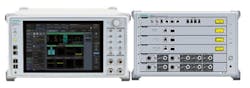
NTN-integrated fixed wireless access (FWA) and customer premises equipment (CPE) solutions are emerging in regions lacking terrestrial broadband infrastructure. RF and parametric testing ensure that these devices maintain stable connectivity despite satellite dynamics.
Handover Tests
Rapid satellite motion and beam movement and footprint changes create challenging handover scenarios in an NTN environment. To compensate, the amount of overhead signaling must be reduced to ensure seamless transition from satellites, especially if there’s a handover between a terrestrial base station to NTN.
Measurements of critical performance parameters, such as latency, signal strength, and throughput, must be made to evaluate the quality of handovers. This can be done through a simulated environment that creates the various real-world scenarios associated with NTN. In addition, signal-integrity testing should be done to ensure that the quality of the signal remains strong during handovers. Enhanced mobility improvements defined in 3GPP Release 18 should also be validated.
Protocol Testing
To accurately evaluate the protocols implemented in NTN-compatible chipsets and devices, it’s necessary to set up multiple test cases. Examples include:
- Testing under varying propagation delay profiles
- LEO/GEO Doppler and timing offsets
- NTN-to-terrestrial roaming
- Beam change and satellite visibility interruptions
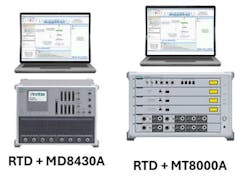
Solutions, such as the analyzers shown in Figure 2, that support the rapid creation and evaluation of these test cases enable efficient development and performance verification of chipsets and devices.
Conformance Testing
To ensure the quality of NTN-compatible devices, conformance testing that complies with the latest 3GPP standards — (TS 38.521-4 (NR NTN RF) and TS 36.521-4 (NB-IoT NTN RF) — is required. The most cost-effective solutions are built on flexible platforms to create test environments that can meet today’s requirements, as well provide an easy and seamless upgrade path as standards evolve. Such an approach is more time- and cost-efficient to help speed time-to-market and lower cost-of-test.
Conclusion
NTNs are filling a valuable void in wireless connectivity, but they bring a new set of validation challenges. Engineers designing chipsets, devices, and modules for NTNs need to create test environments that efficiently address the unique measurement requirements to ensure operation in the field.
Read more articles in this special report
 cellular_dreamstime_l_73406034
About the Author
Raghul Premkumar
Business Development/Applications Engineer, Anritsu
Raghul Premkumar is a Business Development/Applications Engineer at Anritsu.
Related
 Leaders Logo
Leaders relevant to this article: